A strong MSME delayed-payment claim is not a ledger balance plus interest. It should show why the claimant is a statutory supplier, why the chosen MSEFC has jurisdiction, what was supplied, when payment became due under Section 15, what the buyer paid or disputed, what principal remains, how Section 16 interest is calculated, whether the claim is within limitation and what precise relief is sought.
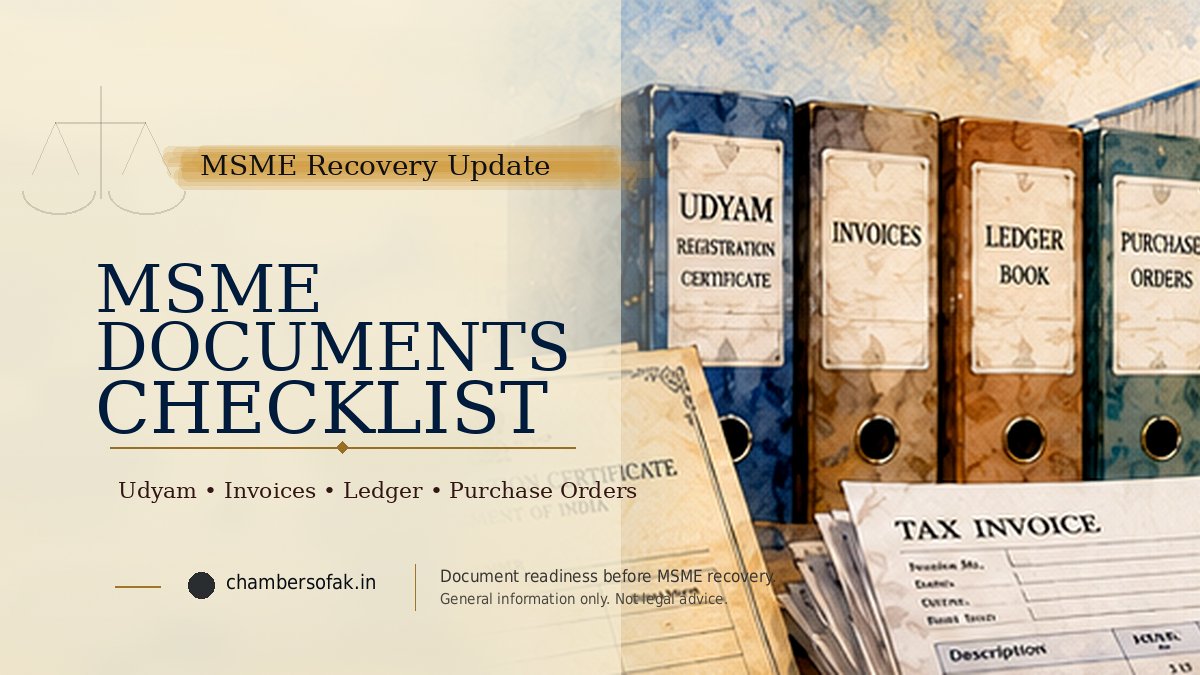
Claim preparation in one minute
- Confirm the correct supplier entity, micro/small status and registration history.
- Confirm the supplier-side MSEFC jurisdiction.
- Create a master invoice schedule before drafting any pleading.
- Match every invoice to the order/contract and delivery or service evidence.
- Calculate the Section 15 due date invoice by invoice.
- Map every payment, credit note, return and admitted adjustment.
- Calculate Section 16 interest separately from principal.
- Prepare a limitation chart before filing.
- Organise acknowledgments, part-payments and buyer communications by date.
- Draft the facts, legal basis and relief from the schedules—not the other way around.
Start with the claimant, not with the unpaid amount
The first question is whether the entity proposing to file is the same legal entity that supplied the goods or rendered the services. Collect the Udyam registration, constitution documents, PAN/GST identity where relevant, bank account details, invoices and contractual documents.
The delayed-payment chapter is directed to statutory suppliers within the MSMED Act. A business should not assume that the word "MSME" on a certificate or invoice resolves every eligibility issue.
Registration timing is also legally sensitive. Earlier Supreme Court decisions and the 2025 NBCC (India) Ltd. larger-Bench reference mean that historical registration, contract dates and supply dates should be preserved rather than simplified into a blanket rule.
Step 1: create a registration and entity chronology
| Item | What to record |
|---|---|
| Legal entity | Proprietorship, partnership, LLP, company or other claimant identity. |
| Registration | Udyam/UAM/EM number, date and historical changes. |
| Classification | Micro or small classification relevant to the transaction period. |
| Supplier unit | Location/unit that actually supplied the goods or services. |
| Contract date | Date of work order, purchase order, agreement or accepted quotation. |
| Supply period | First and last material invoice/service date. |
This chronology helps with supplier status, registration-timing objections and territorial jurisdiction before the monetary claim is even calculated.
Step 2: confirm the correct MSEFC jurisdiction
Under the presently operative Section 18(4), the starting territorial rule is supplier-side. The Council or ADR centre may act where the supplier is located even if the buyer is located elsewhere in India.
Do not select a Council merely because the buyer's head office, project site or payment office is there. Where the supplier has multiple units or addresses, match the actual transaction and registration record to the forum invoked.
See the inter-State MSEFC jurisdiction guide and the separate Bihar and Delhi filing guides where relevant.
Step 3: build the master invoice schedule
The master schedule should be the factual backbone of the claim. Every figure in the pleading should be traceable to it.
| Column | Purpose |
|---|---|
| Invoice / milestone | Unique transaction identifier. |
| Invoice date | Commercial date; not automatically the statutory due date. |
| PO / WO / contract | Document creating the order or payment term. |
| Delivery/service date | Starting evidence for acceptance/deemed acceptance. |
| Written objection | Date and description of any buyer objection within the statutory period. |
| Acceptance date | Actual/deemed acceptance or objection-removal date as legally applicable. |
| Agreed payment term | Written credit period, if any. |
| Section 15 due date | Legally calculated payment deadline. |
| Invoice amount | Gross amount claimed before credits. |
| Payments | Date, amount and allocation. |
| Credits/returns | Credit notes, accepted returns and adjustments. |
| Principal outstanding | Net principal after genuine adjustments. |
| Interest start | Date Section 16 interest begins. |
| Limitation date | Proposed accrual/expiry and relevant interrupting events. |
Invoice date is not automatically the Section 15 due date
Section 15 requires payment on or before the date agreed in writing, subject to the statutory ceiling of forty-five days from acceptance or deemed acceptance. Where no payment date is agreed in writing, payment must be made before the appointed day.
Section 2(b) defines the appointed day by reference to a fifteen-day acceptance framework. It also distinguishes actual acceptance, deemed acceptance and a written objection raised by the buyer within fifteen days of delivery or rendering of services.
Accordingly, calculate the due date from the transaction record rather than using a shortcut such as "invoice date + 45 days". The detailed methodology is addressed in the Section 15 payment-timeline guide.
Written payment terms need to be proved
If the supplier relies on a contractual payment term, identify the document that contains it: agreement, purchase order, work order, accepted quotation, rate contract or another writing forming part of the transaction.
A claim should not merely state that "payment was due in 30 days" if the record contains no writing supporting that term. Where there is no written term, the appointed-day rule becomes material.
If the written term purports to allow more than forty-five days from acceptance/deemed acceptance, Section 15's ceiling must be considered.
Acceptance and buyer objections can change the timeline
The Act gives significance to a written objection concerning acceptance of the goods or services made within fifteen days of delivery or rendering. If such an objection is made within the statutory period, the acceptance analysis can shift to the date the supplier removes the objection.
Collect inspection reports, rejection emails, service tickets, NCRs, return records and the supplier's response/remedial record. Do not ignore a timely written objection merely because the supplier considers it unjustified.
Likewise, a late complaint should not automatically be treated as a statutory acceptance objection. Date and wording matter.
Step 4: prove the underlying supply or service
An invoice proves that a demand was raised; it does not always prove that the buyer ordered, received and accepted the goods or services.
Match each invoice to the strongest available performance evidence: purchase/work order, delivery challan, goods-receipt note, e-way record where relevant, installation record, service report, milestone certificate, completion certificate, acknowledgment email or part-payment.
The Ministry's Samadhaan FAQ expressly recognises invoice acknowledgments, delivery challans, part-payments and email as relevant supporting evidence.
What if there is no written purchase or work order?
The Ministry's Samadhaan FAQ says a work order is compulsory for portal filing and, where the purchase order was oral, an affidavit to that effect is to be submitted.
That affidavit should be supported by the commercial record. Useful evidence may include quotations, buyer emails/messages, delivery challans, goods-receipt records, tax/e-way documents where relevant, part-payments, buyer ledger entries and later acknowledgments.
The legal claim should explain how the order arose rather than hiding the absence of a formal purchase order.
Step 5: reconcile all payments before claiming principal
Prepare a buyer-payment schedule from bank records rather than relying solely on the supplier ledger. Record UTR/reference number, date, amount and allocation against invoices.
If the buyer made an unallocated lump-sum payment, explain the supplier's proposed appropriation and preserve the correspondence/ledger basis for it. Do not silently allocate payments in a way that maximises interest without disclosing the methodology.
Include genuine credit notes, returns and agreed deductions. An exaggerated principal figure weakens both the claim and the interest calculation built on it.
Step 6: separate principal from Section 16 interest
Section 16 creates a statutory liability for compound interest with monthly rests at three times the RBI Bank Rate, beginning from the appointed day or the day immediately following the agreed payment date, as applicable.
The claim should present principal and interest as separate components. A defensible interest worksheet should show the invoice, Section 15 due date, outstanding balance, each payment, applicable Bank Rate period, statutory multiplier, monthly rests and calculation cut-off.
Do not use a fixed percentage simply because it appeared in an earlier claim. The Bank Rate can change over time. See the Section 16 compound-interest guide.
Do not claim interest on amounts already paid
Where a payment is received, the interest calculation must reflect it from the legally relevant date and on the correct outstanding amount. The worksheet should make the treatment visible.
If the payment allocation itself is disputed, identify the competing allocation rather than concealing the issue inside a single total.
Step 7: prepare a limitation chart before filing
MSME status does not create an unlimited claim period. The Limitation Act applies when the dispute reaches Section 18(3) arbitration.
The Supreme Court in Sonali Power Equipments held that even a time-barred debt may be taken into Section 18(2) conciliation for possible settlement, but the Limitation Act governs the adjudicatory arbitration stage.
Accordingly, prepare limitation invoice by invoice or milestone by milestone. Do not wait for the buyer to raise limitation after the claim has been converted into a case.
Acknowledgment and part-payment must be analysed by date
Where the supplier relies on an acknowledgment under Section 18 of the Limitation Act or part-payment under Section 19, the timing and statutory requirements matter.
Collect signed balance confirmations, account confirmations, settlement proposals, emails admitting liability, payment promises and part-payment records. Then identify whether the event occurred before expiry of the relevant limitation period and whether the legal requirements are actually satisfied.
Do not describe every email saying "we are checking your account" as an acknowledgment of debt.
Running accounts do not automatically make every old invoice current
A continuing commercial relationship or running ledger does not by itself reset limitation for all historical invoices. The correct Limitation Act article, mutuality if claimed, acknowledgments, part-payments and contractual structure must be analysed.
For supplier-buyer accounts with one-way invoicing, avoid assuming that the closing ledger balance alone determines limitation.
Step 8: prepare a chronology of buyer admissions and disputes
Create a short date table covering the first supply, material invoices, reminders, buyer objections, reconciliations, balance confirmations, part-payments, settlement meetings and final demand.
This chronology often becomes more useful than reproducing dozens of emails in the body of the claim. The pleadings can cite the chronology and the annexures can preserve the complete documents.
Step 9: draft the statement of facts from the schedules
A useful fact structure is:
- Identity and status of the supplier.
- Identity of the buyer.
- Jurisdiction of the Council.
- Contract/order and nature of goods/services.
- Supply/performance chronology.
- Invoices and payment terms.
- Payments, defaults and outstanding principal.
- Buyer acknowledgments or material disputes.
- Section 15 due-date basis.
- Section 16 interest basis.
- Limitation basis.
- Reference to Section 18 and relief sought.
The pleading should explain the claim; it should not merely copy the ledger.
Step 10: plead jurisdiction expressly
State why the invoked MSEFC has territorial jurisdiction. Identify the supplier's location and relevant registration/unit record rather than leaving the Council to infer jurisdiction from an address in an invoice.
If the buyer is in another State, state that fact and explain the Section 18(4) supplier-location basis.
If the supplier has multiple units or registrations, explain why the unit connected with the transaction supports the selected forum.
Step 11: state the claim amount in components
| Component | How to present it |
|---|---|
| Principal | Total unpaid invoice balance after credits and payments. |
| Section 16 interest to filing date | Separate calculated figure with annexed worksheet. |
| Continuing interest | Claim statutory continuing interest until payment/realisation as legally permissible. |
| Costs | Claim only on an appropriate legal/procedural basis rather than as an unexplained lump sum. |
| Other contractual claim | Keep distinct from the Section 17 delayed-payment amount and explain arbitral scope. |
Do not inflate the claim with unsupported contractual damages
The statutory delayed-payment claim is centred on the amount due for goods/services and Section 16 interest. If the supplier also wants damages or another contractual relief, analyse whether it falls within the arbitral scope and whether it is properly pleaded and proved.
Do not blend a speculative damages figure into the statutory principal balance.
Step 12: organise annexures so the Council can use them
A practical annexure sequence is:
- Supplier registration and entity documents.
- Purchase/work order or agreement.
- Invoice schedule.
- Invoices.
- Delivery/service records.
- Buyer objections and supplier responses.
- Ledger and payment schedule.
- Bank/UTR proof.
- Credit notes/returns.
- Admissions, balance confirmations and settlement correspondence.
- Section 16 interest worksheet.
- Limitation chart.
- Demand/reminder correspondence.
- Service proof and portal/Council acknowledgment.
Use page numbering and a document index. A large PDF without navigation is not a well-prepared claim merely because every document is technically included.
Can multiple invoices be filed together?
The Ministry's Samadhaan FAQ states that multiple invoices may be combined into one PDF for upload. That should be treated as a technical upload facility, not permission to collapse the claim into a single unexplained figure.
Keep the invoice schedule separate and use consistent invoice numbering across the pleading, worksheet and annexures.
Step 13: prepare for the buyer's likely defences before filing
Review the file from the buyer's side. Ask whether the buyer can plausibly say that the claimant was not the supplier, the Council lacks jurisdiction, supply was incomplete, goods were defective, services were rejected, payments were omitted, limitation expired, credits were ignored or interest was miscalculated.
A claim should address obvious documentary weaknesses before filing rather than leaving them for the buyer's statement of defence.
See the buyer response and defence guide for the principal defence categories.
Step 14: distinguish conciliation strategy from arbitration strategy
Section 18 begins with conciliation. A supplier should know its settlement floor, principal reconciliation and interest position before the first meaningful conciliation discussion.
If conciliation fails, the file must be capable of transitioning into formal arbitration. The evidence, limitation and relief should therefore already be organised as an adjudicatory record.
Do not make the initial filing so informal that the supplier has to reconstruct the entire case after conciliation fails.
Demand notice before MSEFC: useful, but do not confuse it with the statutory reference
A pre-reference demand notice can help crystallise the amount, invite reconciliation and obtain an acknowledgment or settlement response. It can also identify whether the buyer disputes quality, quantity or payment allocation.
But a demand notice is not the Section 18 reference itself. The statutory proceeding begins through the reference to the MSEFC mechanism.
Do not allow repeated informal demands to consume the limitation period.
MSME Samadhaan is the filing interface, not the merits decision
The Ministry states that Samadhaan facilitates online delayed-payment applications and automatically forwards them to the concerned State/UT MSEFC. The Ministry itself does not adjudicate the claim.
The Ministry's FAQ also states that the concerned MSEFC converts an application into a regular reference/claim case. Accordingly, preserve the Samadhaan acknowledgement and track whether the Council has actually taken up or converted the application.
Portal acceptance should not be described as a judicial finding that the claim is maintainable, within limitation or payable.
Physical filing may still matter
The Ministry FAQ states that delayed-payment applications are not mandatorily restricted to the online portal and that physical applications can also be filed before the concerned MSEFC.
State rules and Council practice can require affidavits, court-fee/processing-fee material, printed sets, service proof or other documents. Follow the current Council direction in addition to the online submission.
A practical claim-preparation table
| Question | If the answer is unclear |
|---|---|
| Who supplied? | Resolve entity/registration mismatch before filing. |
| Where is the supplier located? | Do not assume buyer location decides MSEFC jurisdiction. |
| What was ordered? | Collect written order or explain oral order with corroboration. |
| Was it delivered/performed? | Find delivery/service evidence. |
| When was payment due? | Apply Section 15; do not default to invoice + 45 days. |
| What was paid? | Reconcile ledger against bank records. |
| What is outstanding? | Separate principal from interest. |
| Is it within limitation? | Prepare invoice-wise limitation chart before filing. |
| How is interest calculated? | Prepare a reproducible Section 16 worksheet. |
| What relief is sought? | State principal, accrued interest, continuing interest and appropriate costs separately. |
Common claim-preparation mistakes
- Claiming the closing ledger balance without an invoice schedule.
- Assuming every invoice automatically gets 45 days.
- Ignoring timely written buyer objections.
- Omitting part-payments or credit notes from principal.
- Using one interest rate for the entire historical period without checking Bank Rate changes.
- Filing old invoices without a limitation analysis.
- Relying on later registration without preserving historical registration details.
- Choosing the buyer's State instead of analysing supplier-side jurisdiction.
- Uploading documents without page numbers/indexing.
- Using a portal acknowledgment as if it proves the merits.
- Combining principal, statutory interest and speculative damages into one figure.
- Waiting until arbitration to organise the evidence.
Current 2026 statutory transition
Status as of 5 October 2026: this guide uses the presently operative Sections 15 to 18 of the MSMED Act and the current Samadhaan/Udyam framework. The MSMED (Amendment) Act, 2026 has received Presidential assent but provides for commencement on date or dates notified by the Central Government.
The official materials reviewed for this publication did not establish commencement of the substituted delayed-payment provisions. A live claim should therefore verify the latest Gazette notification immediately before filing.
Future statutory wording should not be used to recalculate existing claim procedure merely because the amending Act has received assent.
Frequently asked questions
What is the single most important document in an MSME claim?
There is no universal single document, but the master invoice schedule is usually the most important organisational document because it ties the order, delivery, due date, payment, interest and limitation position together.
Can I file only invoices and ledger on Samadhaan?
That may be insufficient for a disputed claim. The supplier should preserve the order/contract, delivery or service proof, payment records, registration, interest calculation and limitation material needed to prove the claim if conciliation fails.
Should I calculate interest up to the filing date?
Yes, a clear accrued-interest figure to a stated cut-off date is useful, together with a prayer for continuing statutory interest as legally permissible. Keep the calculation capable of being updated.
Can an oral purchase order support an MSME claim?
The Ministry FAQ contemplates oral purchase orders for Samadhaan filing through an affidavit. The supplier should also file corroborative evidence showing the order and subsequent supply or service.
Can a claim contain invoices from different years?
Potentially yes, but each invoice or milestone should be tested for limitation, payments, acknowledgments and the applicable transaction record. A single running ledger should not replace that analysis.
Do I need a legal notice before filing?
The Section 18 reference is the statutory mechanism. A prior demand notice can be commercially and evidentially useful, but it should not be allowed to delay filing where limitation is approaching.
Conclusion
An MSME delayed-payment claim should be built from schedules and evidence before the pleading is written. The claimant should be able to answer, for every material invoice: who supplied, what was supplied, when it was accepted, when payment became due, what was paid, what remains, how interest is calculated and why the claim is still legally enforceable.
Once that structure exists, the Samadhaan/MSEFC filing becomes much more than an online complaint—it becomes a claim file capable of surviving buyer objections, failed conciliation and formal arbitration.
Last updated on: 05/10/2026 at 21:04
Useful Internal Pages
References / Sources
- Micro, Small and Medium Enterprises Development Act, 2006 - India Code, including Sections 2(b), 15, 16, 17 and 18.
- Ministry of MSME RAMP - current MSME Samadhaan delayed-payment overview.
- Ministry of MSME Champions FAQ - Samadhaan filing, work order, oral-order affidavit, multiple invoices and supporting evidence.
- Sonali Power Equipments Pvt. Ltd. v. Chairman, Maharashtra State Electricity Board, 2025 INSC 864 - limitation at conciliation and arbitration stages.
- NBCC (India) Ltd. v. State of West Bengal, 2025 INSC 54 - registration-timing issue referred to larger Bench.
- Ministry of MSME - Orders and Notices, including the MSMED (Amendment) Act, 2026.