A buyer should not answer an MSEFC notice with a generic denial or ignore it while waiting for a later arbitration notice. The first task is to identify the stage, then reconcile the claim invoice by invoice and preserve any objections concerning supplier status, territorial jurisdiction, limitation, supply or service performance, payments, debit or credit adjustments, counterclaims and statutory interest. Conciliation and arbitration are legally different stages, and the response strategy should reflect that distinction.
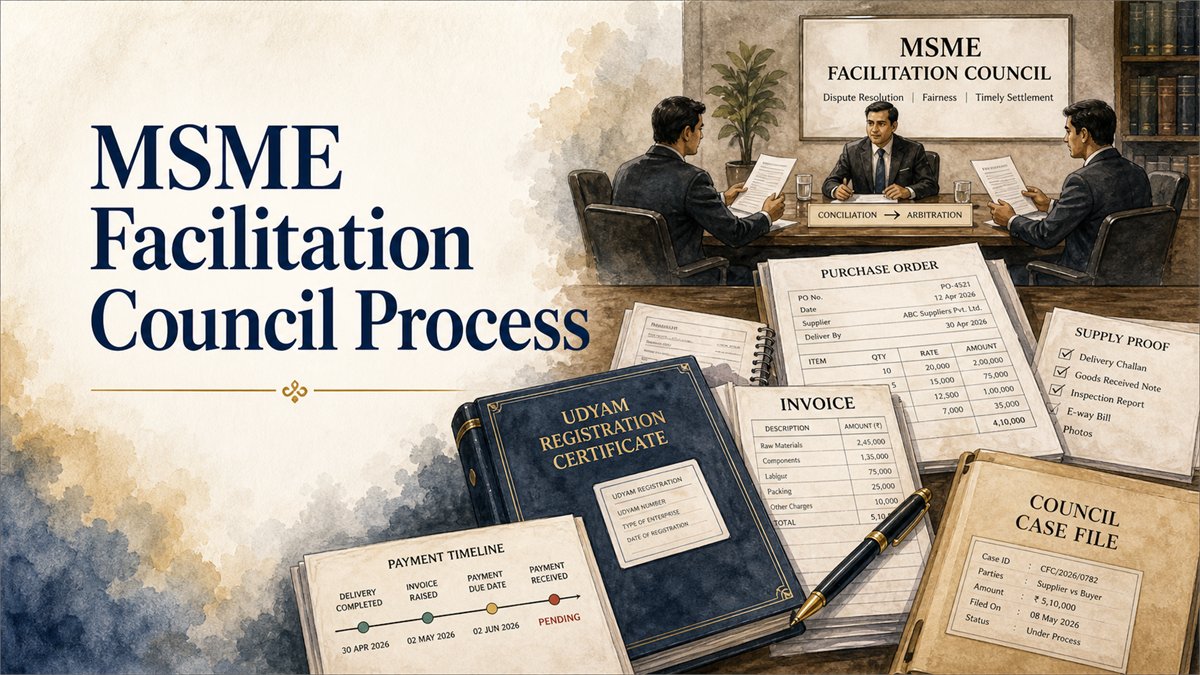
Buyer response in one minute
- Do not ignore the notice. First identify whether the matter is at reference, conciliation, arbitration or post-award stage.
- Obtain the complete claim, invoice schedule and documents relied on by the supplier.
- Prepare an invoice-wise reconciliation: amount claimed, goods/services received, objections, payments, credit/debit notes and balance admitted or disputed.
- Check the claimant's micro/small supplier status, registration history and the correct MSEFC jurisdiction.
- Raise limitation separately for each material invoice or milestone where applicable.
- Preserve quality, delay, short-supply, performance, liquidated-damages, set-off and other contractual records.
- A formal counterclaim or set-off is maintainable in Section 18(3) arbitration, subject to the Arbitration Act.
- If an adverse award is possible, prepare the Section 34 limitation, Section 19 pre-deposit and stay strategy before the award arrives.
Step 1: identify what kind of MSEFC notice you have received
Not every MSEFC communication means the case is already at arbitration. The file may be at the initial reference stage, conciliation under Section 18(2), the transition after failed conciliation, arbitration under Section 18(3), or post-award enforcement.
The distinction matters because the purpose of the response changes. Conciliation is a settlement process. Arbitration is adjudication: pleadings, jurisdiction objections, documents, evidence and counterclaims become formal issues.
Read the notice, order sheet and case status together. Record the case number, Council, claimant, claim amount, date of service, next date, stage stated by the Council and the exact direction for filing a reply or appearing.
Do not treat non-participation as a defence strategy
The Supreme Court in Jharkhand Urja Vikas Nigam Ltd. v. State of Rajasthan held that failure to participate in conciliation does not permit the Council to skip the statutory arbitration stage and simply make an award. Conciliation and arbitration are distinct and cannot be clubbed.
That protection should not be misunderstood as permission to ignore the case. The Arbitration and Conciliation Act permits proceedings to continue where a respondent fails to communicate its defence or appear, subject to the applicable safeguards. The claimant must still prove its case, but the buyer loses the practical advantage of placing its own documents and objections on record.
In Shri Chain Perfumery Works v. Union of India, decided on 5 March 2026, the Madhya Pradesh High Court upheld an ex parte MSEFC award where the buyer had been given opportunities, stated that it was not interested in conciliation and then did not participate for a prolonged period. The practical lesson is straightforward: preserve objections by participating, not by silence.
Step 2: check whether the claimant is within the MSMED delayed-payment framework
Chapter V of the MSMED Act concerns delayed payments to micro and small enterprises. The statutory definition of "supplier" should be checked against the claimant's actual legal entity, enterprise classification and transaction documents.
Obtain the Udyam or applicable registration record, PAN/GST identity where relevant, constitution documents and invoices. Confirm that the claimant before the Council is the same entity that contracted, supplied the goods or rendered the services.
Do not rely on the label "MSME" alone. The statutory claim should be tested against the entity, classification, transaction and current law.
Registration timing: preserve the objection, but do not assume it automatically ends the case
Older Supreme Court decisions contain observations that registration obtained after the contract or supply cannot retrospectively confer MSMED benefits. The position became materially more complicated after NBCC (India) Ltd. v. State of West Bengal, 2025 INSC 54.
The two-Judge Bench in NBCC held that the precise question whether Section 18 can be invoked without pre-contract registration had not actually been decided in the earlier cases in the manner often assumed. It expressed the view that Section 18 uses the wider phrase "any party to a dispute" and referred the question to a larger Bench for authoritative determination.
As of this update, the larger-Bench reference remains material. Recent Delhi High Court decisions in 2026, including NBCC India Ltd. v. MSEFC, New Delhi and Municipal Corporation of Delhi v. Vijay Bansal, have followed the reasoning in NBCC and declined to halt the Section 18 mechanism merely because registration came after the work order.
Buyer-side approach: collect and plead the registration chronology where it matters, but do not build the entire defence on an assumption that later registration is an automatic threshold dismissal. Preserve the point and also contest the claim on jurisdiction, limitation, liability and quantum where available.
Step 3: check territorial jurisdiction separately
For the presently operative Section 18 mechanism, the starting territorial rule is tied to the supplier's location, even where the buyer is in another State. The buyer's registered office or project location does not by itself determine the competent MSEFC.
A jurisdiction objection should therefore identify a real statutory problem: the claimant is not the relevant supplier, the Council does not cover the supplier's location, the relied-on unit or registration does not match the transaction, or another jurisdictional defect exists.
For a fuller treatment, see the inter-State MSEFC jurisdiction guide.
Step 4: build an invoice-wise reconciliation before drafting the reply
The most useful buyer document is usually not a long legal reply but a clean reconciliation sheet. Each invoice should be mapped against supply, acceptance, objections, payment and adjustment records.
| Column | Buyer-side question |
|---|---|
| Invoice / milestone | Which exact invoice or contractual milestone is being claimed? |
| PO / contract | Which purchase order, work order or agreement governs it? |
| Delivery / service | Was supply or performance completed, partly completed, rejected or returned? |
| Acceptance / objection | Was there a contemporaneous written objection, inspection report, NCR, email or debit note? |
| Payment | What amount was paid, on which date and against which invoice? |
| Adjustment | Is there a credit note, debit note, retention, recovery, set-off or agreed deduction? |
| Limitation | What is the proposed accrual and expiry date and is there any acknowledgment or part-payment? |
| Position | Admitted, partly admitted, disputed, or subject to counterclaim? |
The statement of account relied on by the supplier should be reconciled against the buyer's ledger and bank records rather than accepted as a single balance figure.
Written objections within 15 days can affect the Section 15 payment timeline
The MSMED Act distinguishes between acceptance and deemed acceptance. Where the buyer raises a written objection regarding acceptance of goods or services within fifteen days of delivery or rendering, the statutory acceptance date can shift to the date on which the supplier removes that objection.
Accordingly, preserve inspection reports, rejection emails, quality complaints, service tickets, return records and written defect notices generated at the relevant time.
A later commercial dispute may still be relevant to liability, but it should not automatically be treated as if it were a timely statutory acceptance objection. The actual communication date and wording matter.
Quality, short-supply and performance defences need contemporaneous proof
A bare statement that "the goods were defective" or "services were unsatisfactory" is weak if the buyer accepted delivery, used the goods, made partial payments and raised no contemporaneous complaint.
Where the defence is genuine, collect inspection reports, inward/GRN records, laboratory or technical reports, photographs, rejection communications, replacement requests, service-level reports, delay correspondence, site records, third-party complaints and internal approvals imposing contractual deductions.
Separate a dispute over the existence of liability from a dispute over the amount. A buyer may admit part of an invoice while disputing the balance. The reply should reflect that distinction rather than denying everything.
Step 5: raise limitation invoice by invoice
The Limitation Act applies when the dispute proceeds to arbitration under Section 18(3). There is no safe universal formula of "three years from every invoice date"; the applicable Schedule article and starting date depend on the transaction.
The Supreme Court's 2025 decision in Sonali Power Equipments also distinguishes conciliation from arbitration: a time-barred debt may still be discussed in Section 18(2) conciliation for possible settlement, while limitation applies to adjudication under Section 18(3).
A buyer should therefore prepare a separate limitation chart and plead the defence at the arbitral stage. See the MSME limitation guide for invoice dates, credit terms, acknowledgments and part-payments.
Be careful with balance confirmations, reconciliations and payment emails
A reply should be accurate, authorised and based on the ledger. A qualifying written acknowledgment made before expiry of limitation can start a fresh limitation period under Section 18 of the Limitation Act, and a qualifying part-payment may have consequences under Section 19.
This does not mean a buyer should avoid genuine admissions. It means the business should not casually sign an unreconciled balance confirmation or send a blanket statement such as "the entire amount is payable" when the ledger actually contains disputed invoices, returns, deductions or payments.
Where part of the amount is admitted, state the basis and keep the disputed components separately identified.
Step 6: use conciliation as conciliation, not as informal arbitration
Under the presently operative Section 18(2), the Council either conducts conciliation or refers it for conciliation, with Sections 65 to 81 of the Arbitration and Conciliation Act applying.
The purpose is to explore settlement, not to adjudicate disputed evidence. Sections 75 and 81 also provide confidentiality and evidentiary protections for specified conciliation material, including certain admissions, proposals and willingness to accept settlement proposals.
Those protections do not erase the underlying commercial documents. Purchase orders, invoices, inspection records, emails and ledgers that existed independently remain part of the documentary record. The buyer should distinguish settlement communications from evidence that will be needed if conciliation fails.
Can the Council move to arbitration without a fresh separate notice?
The Council cannot lawfully collapse conciliation and arbitration into one undifferentiated exercise. Jharkhand Urja Vikas Nigam confirms the two stages are distinct, and recent decisions continue to scrutinise whether Section 18(2) was actually complied with.
However, a buyer should not assume that a brand-new notice carrying the word "arbitration" must always arrive before the matter can proceed. In Shri Chain Perfumery Works, the Madhya Pradesh High Court held on the facts that no separate notice was required after the buyer had received the claim, had the opportunity to respond and had itself declined conciliation.
Track every order sheet and communication from the Council. If conciliation fails, prepare the statement of defence immediately rather than waiting for a procedural event that may never take the form expected.
Procedural defence: was conciliation actually conducted and terminated?
The Supreme Court in Jharkhand Urja Vikas Nigam held that the Council is obliged to conduct conciliation before arbitration and cannot pass an award merely because a buyer did not appear at the conciliation stage.
In Wapcos Ltd. v. Virgo Aqua, decided by the Delhi High Court on 1 July 2026, an ex parte award was set aside where the statutory transition from conciliation to arbitration and the opportunity to present the buyer's case were found deficient.
Likewise, the Madhya Pradesh High Court in Aurionpro Solutions Ltd. v. MSEFC, Bhopal held in May 2026 that conciliation cannot be reduced to an "eyewash"; on the facts, the Council had merely asked the parties to settle among themselves instead of conducting the statutory process.
These are fact-sensitive procedural objections. They should be raised from the Council record, not as a generic argument in every case.
Step 7: prepare a proper statement of defence for Section 18(3) arbitration
Once arbitration begins, the buyer should move from settlement correspondence to structured pleadings. The response should identify preliminary objections, admissions and denials, invoice-wise facts, payment history, contractual defences, limitation, jurisdiction and the relief sought.
The arbitral tribunal can rule on its own jurisdiction under Section 16 of the Arbitration and Conciliation Act. Mahakali Foods confirms that this principle applies to Section 18(3) proceedings.
Do not bury a jurisdiction objection inside a general denial. State the legal and factual basis clearly and at the appropriate stage.
Counterclaim and set-off are available to the buyer
The Supreme Court in Silpi Industries v. Kerala State Road Transport Corporation held that counterclaim and set-off are maintainable in arbitration under Section 18(3). The Court relied on Section 23(2A) of the Arbitration and Conciliation Act and the statutory deeming of the Section 18(3) arbitration as one pursuant to an arbitration agreement.
A buyer may therefore be able to claim damages, contractual recovery, overpayment, delay loss or other relief arising within the permissible arbitral scope instead of defending only against the supplier's claim.
A counterclaim is not a substitute for proof. It should be separately quantified, supported by the contract and documents, tested for limitation, and pleaded as a positive claim rather than described vaguely as a "set-off".
Liquidated damages and contractual deductions should not be assumed to prove themselves
If the buyer relies on liquidated damages, penalty, risk-purchase recovery, retention, back-charges or other deductions, identify the exact contractual clause and the event that triggered it.
Collect notices, extension records, delay attribution, completion certificates, third-party replacement costs, internal approval and any contemporaneous calculation. A unilateral debit note may record the buyer's position, but the tribunal can still examine whether the deduction is contractually and factually justified.
Where actual loss is legally relevant, preserve the evidence supporting that loss rather than relying only on the contractual percentage.
Step 8: challenge the Section 16 interest calculation separately from principal liability
Section 16 imposes a statutory interest consequence where payment covered by Section 15 is delayed. A contractual clause prescribing lower interest does not automatically displace the statutory rule.
Buyer-side scrutiny should focus on the correct principal, the Section 15 due date, invoice-wise periods, valid part-payments, credit notes, rate changes and the mathematical application of monthly rests.
A dispute about the interest worksheet should therefore be pleaded separately from the defence that no principal amount is due. See the Section 16 compound-interest guide.
What documents should the buyer collect?
- MSEFC notice, claim petition, annexures and every order sheet.
- Udyam/applicable registration record supplied by the claimant.
- Contract, purchase order, work order, amendments and general/special conditions.
- All invoices and the supplier's statement of account.
- Goods receipt notes, delivery challans, service-completion or milestone records.
- Inspection, quality, rejection, return and replacement records.
- Debit notes, credit notes, retention or recovery calculations.
- Bank statements, UTRs, remittance advice, TDS/GST records where relevant and buyer ledger.
- Email and letter correspondence concerning acceptance, defects, delay, reconciliation and payment.
- Any signed balance confirmation, settlement document or acknowledgment.
- Documents supporting a counterclaim or set-off, including proof of loss where required.
- Arbitration, seat, venue and jurisdiction clauses for later procedural questions.
A practical structure for the buyer's reply
1. Preliminary: identify the notice, case number and stage.
2. Threshold objections: supplier status, jurisdiction, maintainability and limitation where applicable.
3. Contract and transaction: purchase order, scope, delivery/performance and payment terms.
4. Invoice-wise response: admitted, disputed, paid, adjusted or unsupported amounts.
5. Performance issues: quality, short supply, delay, rejection, returns or non-compliance with supporting records.
6. Payments and adjustments: dates, amounts and allocation.
7. Counterclaim/set-off: if the matter is at the arbitral stage and the claim is ready to be pleaded.
8. Interest: challenge the principal and calculation separately where necessary.
9. Procedural request: opportunity to file complete defence/documents and participate in the correct statutory stage.
What should the buyer avoid?
Avoid a one-line denial, unsupported allegations of defective supply, contradictory ledgers, unexplained debit notes and admissions made without checking the account. Do not assume that a contractual arbitration clause automatically removes the MSEFC's statutory role after Section 18 has been validly invoked.
Also avoid treating every procedural objection as a reason not to participate. A buyer can preserve a jurisdiction objection while still filing a defence without prejudice to that objection.
If an adverse award is passed
The response strategy should anticipate the post-award stage. Section 34 limitation is strict; filing a challenge does not automatically stay enforcement; and Section 19 of the MSMED Act ordinarily requires a non-supplier applicant to deposit 75% of the amount in terms of the award before the setting-aside application is entertained.
Prepare the award-receipt record, limitation calculation, Section 19 deposit, possible instalment request, stay application and Section 34 grounds together. See the Section 19 pre-deposit guide.
Current 2026 statutory transition
Status as of 5 October 2026: this guide uses the presently operative Section 18 framework of conciliation followed by arbitration. Section 62 and the Seventh Schedule of the Mediation Act, 2023 contain a future substitution using mediation terminology, but the commencement notification reviewed for this update did not bring Section 62 into force.
The MSMED (Amendment) Act, 2026 has also received Presidential assent and contains further changes to the delayed-payment mechanism. The Amendment Act provides for commencement by Central Government notification. The official materials reviewed for this publication did not establish commencement of the relevant substituted Section 18 provisions.
A live buyer response should therefore verify the latest commencement notification before relying on future mediation or timeline provisions.
Frequently asked questions
Should a buyer reply during conciliation even if the entire claim is disputed?
Yes. The reply can preserve jurisdiction and liability objections while still participating in conciliation. Silence may reduce the buyer's practical ability to control the record and can lead to later ex parte proceedings after due opportunity.
Can the buyer raise a counterclaim before the MSEFC?
At the Section 18(3) arbitral stage, the Supreme Court in Silpi Industries recognises counterclaim and set-off under Section 23(2A) of the Arbitration Act. The counterclaim should be within the arbitral scope, within limitation and properly evidenced.
Is late MSME registration still a valid defence?
It is a point that may need to be preserved, but it is not presently safe to describe it as an automatic threshold defence. The Supreme Court referred the precise issue to a larger Bench in NBCC, and Delhi High Court decisions in 2026 have followed NBCC to allow Section 18 proceedings to continue despite that objection.
Can old invoices be rejected only because they are more than three years old?
No. The correct Limitation Act starting point, acknowledgments, part-payments and other legally relevant events must be checked invoice by invoice. Limitation applies to Section 18(3) arbitration, while conciliation can still address a time-barred debt for settlement.
Does the buyer need to challenge the Section 16 interest rate itself?
The statutory formula is not displaced merely because the contract specifies a lower rate. A more useful defence is often to challenge the principal, due date, invoice period, payment allocation or mathematical calculation where the record supports it.
Can an MSEFC pass an award if the buyer never appears?
An arbitral tribunal can proceed after adequate opportunity in circumstances recognised by the Arbitration Act, but the statutory conciliation and arbitration stages must still be lawfully followed. Non-participation does not entitle the Council to skip the arbitral procedure.
Conclusion
A strong MSEFC buyer response is built from the transaction record, not from a generic objection to the supplier's claim. Start with the procedural stage and supplier identity, then test jurisdiction, limitation, acceptance, performance, payments, adjustments and statutory interest invoice by invoice.
If conciliation fails, the defence should be converted into a proper arbitral pleading, with jurisdiction objections clearly preserved and any counterclaim or set-off positively pleaded and proved. The buyer should participate even while contesting jurisdiction: recent cases show the difference between a genuine procedural defect and a party simply choosing not to use the opportunities it was given.
Last updated on: 05/10/2026 at 18:12
Useful Internal Pages
References / Sources
- Micro, Small and Medium Enterprises Development Act, 2006 - India Code.
- Arbitration and Conciliation Act, 1996 - India Code.
- Silpi Industries v. Kerala State Road Transport Corporation, Supreme Court, 29 June 2021 - limitation and counterclaim/set-off.
- Jharkhand Urja Vikas Nigam Ltd. v. State of Rajasthan, Supreme Court, 15 December 2021 - separate conciliation and arbitration stages.
- Gujarat State Civil Supplies Corporation Ltd. v. Mahakali Foods Pvt. Ltd., Supreme Court, 31 October 2022 - statutory Section 18 mechanism and tribunal jurisdiction.
- NBCC (India) Ltd. v. State of West Bengal, 2025 INSC 54 - registration-timing issue referred to a larger Bench.
- Sonali Power Equipments Pvt. Ltd. v. Chairman, Maharashtra State Electricity Board, 2025 INSC 864 - limitation in conciliation and arbitration.
- NBCC India Ltd. v. Micro and Small Enterprises Facilitation Council, New Delhi, Delhi High Court, 22 April 2026.
- Wapcos Ltd. v. Virgo Aqua, Delhi High Court, 1 July 2026 - conciliation/arbitration transition and opportunity to present the defence.
- Shri Chain Perfumery Works v. Union of India, Madhya Pradesh High Court, 5 March 2026 - non-participation and ex parte proceedings.
- Ministry of MSME - Orders and Notices, including the MSMED (Amendment) Act, 2026.
- S.O. 4384(E), 9 October 2023 - commencement notification under the Mediation Act, 2023.