A Bihar MSEFC claim should be prepared as a statutory delayed-payment reference, not as a bare online complaint. The supplier should first verify eligibility and jurisdiction, prepare an invoice-wise principal and interest record, collect the contract and delivery evidence, file through the current Samadhaan/Council route, preserve proof of service on the buyer and then track the separate scrutiny, conciliation and arbitration stages.
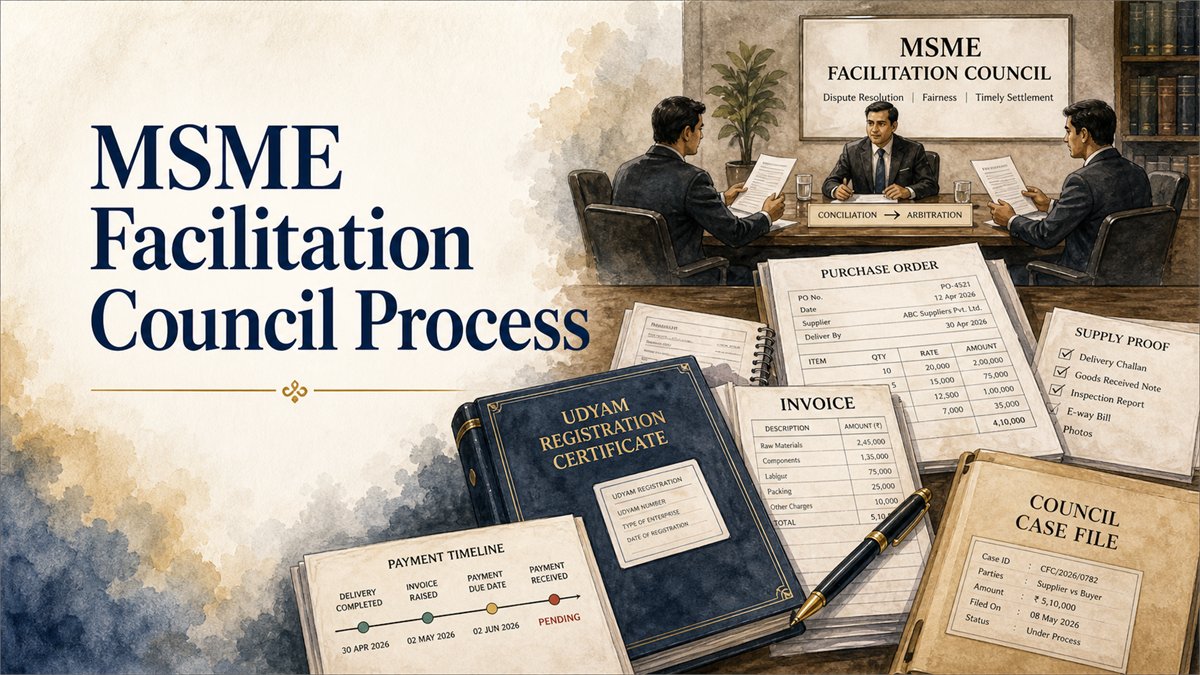
Bihar MSEFC filing in one minute
- Confirm that the claimant is the relevant micro or small enterprise and collect its current Udyam record.
- Check that Bihar is the correct supplier-side MSEFC jurisdiction.
- Prepare an invoice-wise principal, payment and Section 16 interest chart.
- Collect the purchase/work order, invoices, delivery or service records, ledger, payment proof and correspondence.
- Use the current MSME Samadhaan filing route or other filing mode accepted by the Bihar Council.
- Comply with the Bihar Rules concerning claim particulars, affidavit, fee/court-fee requirements and simultaneous service on the buyer.
- Track buyer response, Council scrutiny and the conciliation stage.
- If conciliation fails, prepare for formal Section 18(3) arbitration rather than treating the entire process as one hearing.
Which Council handles a Bihar supplier's delayed-payment claim?
The Bihar Micro and Small Enterprises Facilitation Council Rules, 2007 state that the headquarters of the Council is at the Department of Industries, Vikas Bhawan, Patna. The Rules also state that the Director of Industries exercises the provisions throughout Bihar and that the Council has jurisdiction throughout the State.
That state-wide rule operates with Section 18(4) of the MSMED Act. The relevant MSEFC may act where the supplier is located within its jurisdiction even if the buyer is located elsewhere in India.
Accordingly, a Bihar supplier does not ordinarily shift its Section 18 reference to Delhi, Maharashtra or another State merely because the buyer, project office or payment office is there. See the inter-State MSEFC jurisdiction guide for the separate territorial analysis.
Do not rely only on an old postal address
The 2007 Bihar Rules designate Vikas Bhawan, Patna as the Council headquarters. That is the statutory source located for this guide, but filing counters, room numbers, email addresses and portal instructions can change.
The Ministry of MSME's own Samadhaan FAQ states that after an online application is submitted, it is forwarded to the concerned MSEFC and that the contact address of the concerned Council is mentioned in the acknowledgement sent to the applicant's registered email.
Practical approach: use the current Samadhaan acknowledgement and current Department/Council direction for physical service or follow-up. Do not send an original filing package solely to an address copied from an old notification without verifying the present receiving arrangement.
Who can file on MSME Samadhaan?
The current Ministry of MSME RAMP page describes the delayed-payment mechanism as available to a micro or small enterprise having valid Udyam Registration. Samadhaan is the Ministry's online facility for delayed-payment applications; the application is dealt with by the concerned State/UT MSEFC rather than adjudicated by the Ministry itself.
Portal eligibility and legal maintainability are related but not identical questions. Registration timing, the identity of the statutory supplier and the transaction period can still be contested in the Council proceedings.
The Ministry FAQ page contains some older references to Udyog Aadhaar/UAM. For a current filing, follow the current Udyam/Samadhaan prompts and current Council directions rather than reproducing legacy portal terminology.
Is online filing mandatory?
The Ministry of MSME FAQ says that the Samadhaan portal facilitates online delayed-payment applications but is not the only legally possible mode; physical applications can also be filed before the concerned MSEFC.
For a Bihar matter, the safest current practice is to use the online Samadhaan route where available and then comply with any physical-copy, fee, affidavit, service or additional-document direction issued by the Bihar Council.
An online acknowledgment is not a substitute for checking whether the application has been taken up, converted into a regular reference/case or called for curing defects.
What must the Bihar reference contain?
Rule 5(iv) of the Bihar 2007 Rules requires the reference/application of the aggrieved micro or small enterprise supplier to contain full particulars of the supplier and its status, the goods or services supplied, agreed payment terms if any, actual payment received with dates, the amount due and interest calculated under Section 16.
The same rule contemplates an affidavit and necessary court-fee stamp, and allows the Chairperson to call for further particulars or relevant documents.
If the supplier does not provide the additional material within fifteen days of the communication—or such further time as may be allowed for sufficient cause—the Rules permit termination of the proceedings without prejudice to a fresh reference if otherwise legally maintainable.
Build the claim invoice by invoice
| Claim field | What should be prepared |
|---|---|
| Invoice | Invoice number, date, taxable value, total amount and buyer reference. |
| Supply/service | Delivery challan, GRN, service report, milestone certificate or other performance proof. |
| Payment term | Purchase order, work order, agreement or written credit term. |
| Section 15 date | Acceptance/deemed-acceptance date and statutory due date. |
| Payments | Date, amount, UTR/bank proof and allocation against invoices. |
| Adjustments | Credit notes, admitted deductions, returns and reconciliation entries. |
| Principal due | Balance claimed after genuine payments and adjustments. |
| Section 16 interest | Rate periods, monthly rests and calculation up to the chosen cut-off date. |
| Limitation | Accrual date, acknowledgments, part-payments and proposed limitation position. |
The statutory interest figure should be reproducible. Avoid a single unexplained total that cannot be traced back to invoices and payment dates.
Documents to collect before filing
- Current Udyam Registration record and earlier registration record where relevant.
- Constitution documents of the supplier entity.
- Purchase orders, work orders, agreements and amendments.
- Invoices and an invoice-wise claim chart.
- Delivery challans, goods-receipt records, service certificates and completion/milestone proof.
- Supplier ledger and relevant buyer confirmations or reconciliations.
- Bank statements, UTR/remittance records and payment advice.
- Credit notes, debit notes, returns and adjustment records.
- Emails or letters acknowledging liability, promising payment or recording disputes.
- Section 16 interest worksheet.
- Affidavit and any court-fee/processing-fee material required by the current Bihar filing process.
- Proof showing service of the reference and documents on the buyer.
What does the Ministry portal require for purchase/work orders?
The Ministry's Samadhaan FAQ states that a work order is compulsory for online filing. Where the purchase order was oral, the FAQ requires an affidavit to that effect.
The same FAQ says multiple invoices may be combined into a single PDF for upload. That is a portal-format convenience; the underlying invoice schedule should still be kept separately so the Council can understand principal, payments, interest and limitation invoice by invoice.
What if there was no written purchase order?
An oral order does not mean the file should contain only an affidavit. The supplier should still gather the best contemporaneous proof of the transaction: emails, WhatsApp/business correspondence where lawfully available, quotations, delivery challans, goods-receipt acknowledgments, GST/e-way records where relevant, part-payments and buyer ledger acknowledgments.
The Ministry FAQ's oral-order affidavit requirement should therefore be treated as a minimum portal requirement, not as a substitute for proving that the buyer actually ordered and received the goods or services.
Bihar processing fee: what does Rule 11 say?
Rule 11 of the Bihar MSEFC Rules, 2007 contains the State's processing-fee provision. The published text refers to ₹500 or 0.25% of the value involved, a maximum of ₹5,000, and uses the phrase "whichever is higher".
Because the notification is old and that published wording is not elegantly drafted, this guide does not convert it into a new formula by interpretation. Before remitting the fee, confirm the current amount, head of account/payment instrument and whether the portal or Council has issued a later instruction.
Keep proof of every fee/court-fee payment with the filing set.
Serve the buyer when filing
The Bihar Rules expressly state that the petitioner shall simultaneously send a copy of the reference to the buyer or buyers against whom the reference is made.
Even where the online portal generates system communications, preserve independent proof of service if the current Council procedure expects it. Maintain postal receipt, tracking, email delivery record or other accepted proof together with the exact document set served.
If there are multiple respondents, keep a respondent-wise service sheet so there is no later dispute about which annexures were supplied to whom.
What happens after the reference is received?
Under Rule 5(v), a reference delivered at the Council office is to be acknowledged forthwith; where received by registered post, its receipt is to be acknowledged.
The Chairperson is then to cause the buyer to furnish a detailed response within fifteen days of receipt of the reference. The Rules permit a further period not exceeding fifteen days for sufficient cause.
The supplier should therefore monitor not merely whether notice was issued, but whether the buyer has filed its detailed response and whether the Council has sought any rejoinder, reconciliation or additional document.
Preliminary scrutiny before the Council meeting
Rule 5(vi) provides for examination of the reference and the buyer's response. If a prima facie case of delayed payment is found, the reference is to be placed before the Council at its next immediate meeting for consideration.
The rule also states that a reference received within two weeks of the previous meeting should be examined and, if in order, placed before the next immediate meeting.
This is a procedural framework, not a guaranteed listing date. Suppliers should track the actual case status and communications rather than calculating a hearing date mechanically from the rule.
Conciliation comes before arbitration
The Bihar Rules mirror the Section 18 structure: the Council first conducts conciliation itself or sends the matter to an institution/centre providing ADR services. Sections 65 to 81 of the Arbitration and Conciliation Act apply to the conciliation process under the presently operative Section 18 framework.
The Council or institution requires both sides to appear and first makes efforts to bring about settlement. If conciliation succeeds, the dispute can end without a contested award.
If conciliation does not result in settlement, the matter moves to arbitration under Section 18(3). The two stages should not be treated as one continuous merits hearing. See the MSEFC process guide.
What happens at the arbitration stage?
When conciliation fails, the Bihar Rules provide that the Council may itself act as arbitrator or refer the dispute to an institution for arbitration in accordance with the Arbitration and Conciliation Act.
The supplier's claim should then be capable of standing as an arbitral case: clear pleadings, jurisdiction basis, invoice evidence, payment calculation, limitation analysis and relief. The buyer can file its statement of defence and, where legally maintainable, counterclaim or set-off.
The Rules expressly state that the supplier or buyer may present its case during arbitration in person or through a lawyer registered with any court. Current hearing directions should still be checked for the particular proceeding.
Can the Council take evidence?
The Bihar Rules permit the Council to appoint or engage experts in terms of Section 26 of the Arbitration and Conciliation Act. They also contemplate an application to the court under Section 27 for assistance in taking evidence.
In ordinary invoice matters, the decisive record may remain documentary. Still, technical quality disputes, measurement disputes or specialised performance issues can make expert or additional evidence relevant.
Decision, quorum and Council meetings
The Bihar Rules state that Council decisions are made by majority of the members present. They prescribe quorum as the Chairperson and any two members.
The Rules also state that the Council shall hold a meeting at least once in three months for transaction of its business.
These provisions concern the institutional procedure. They do not mean every pending delayed-payment matter will be finally disposed at the next quarterly meeting.
Is there a 90-day deadline?
Section 18(5) of the presently operative MSMED Act states that every reference should be decided within ninety days from the date of making the reference. The Bihar Rules direct the Council to make an arbitral award within the statutory period.
The statutory text should be cited as a timeline requirement, not marketed as a guaranteed disposal date. Actual proceedings may involve service, defects, adjournments, conciliation, evidence, referral to an institution and other procedural events.
Do not file without checking limitation
A correctly filed Bihar reference does not revive a claim that is already legally time-barred at the adjudicatory stage. Limitation applies to Section 18(3) arbitration.
The Supreme Court in Sonali Power Equipments distinguishes that position from Section 18(2) conciliation, where even a time-barred debt can still be discussed for settlement.
Prepare the limitation chart before filing, particularly where invoices are old, payments were irregular or the supplier relies on balance confirmations. See the MSME limitation guide.
Registration timing also requires legal review
Do not assume that successful portal submission conclusively decides whether MSMED benefits are available for every historical transaction. Registration timing remains a live legal issue after the Supreme Court's 2025 NBCC (India) Ltd. larger-Bench reference.
The claimant should preserve historical Udyam/UAM/EM registration records and identify the registration position on the dates of the relevant supplies. The buyer should raise any genuine objection in its response rather than relying solely on portal screening.
Bihar supplier against an out-of-State buyer
A Bihar-based statutory supplier may invoke the Bihar MSEFC mechanism against a buyer located elsewhere in India because Section 18(4) is supplier-location oriented.
A 2024 Patna High Court decision involving the Bihar State Food and Civil Supplies Corporation and a Maharashtra supplier applied Section 18(4) in the converse setting: the supplier-side Council outside Bihar was not deprived of jurisdiction merely because the buyer was in Bihar.
The practical point is the same—identify the supplier's legally relevant location, not simply the buyer's address.
What should the buyer do after receiving a Bihar MSEFC notice?
The buyer should diarise the response deadline immediately, obtain the complete reference and annexures, and prepare an invoice-wise reconciliation. Threshold objections concerning supplier status, jurisdiction and limitation should be preserved along with substantive payment, quality and performance defences.
Rule 5 gives a detailed-response period of fifteen days with only a limited further period. A buyer should therefore not wait for arbitration before collecting the ledger, purchase orders, inspection records, payment proof, debit notes and counterclaim evidence.
See the MSEFC buyer response and defence guide.
What happens after an award?
An MSEFC arbitral award moves into the Arbitration Act post-award framework. A challenge under Section 34 is subject to strict limitation, a non-supplier challenger ordinarily faces the Section 19 75% pre-deposit, and filing Section 34 does not automatically stay enforcement.
If the award is enforceable and unstayed, it can be enforced under Section 36 in the manner of a court decree.
See the post-award MSEFC challenge, stay and enforcement guide.
Bihar filing checklist before submission
- Confirm claimant entity, micro/small classification and Udyam details.
- Confirm Bihar supplier-side jurisdiction.
- Prepare invoice-wise principal, payment and limitation charts.
- Prepare the Section 16 interest worksheet.
- Index purchase orders, invoices and supply/service proof.
- Include affidavit material required by the Bihar Rules and portal, especially for an oral purchase order.
- Check the current processing-fee and court-fee method rather than relying on an old payment practice.
- File through the current Samadhaan/Council route.
- Serve the complete reference on every buyer/respondent and keep proof.
- Preserve the portal acknowledgment and use the current Council contact shown there for follow-up.
- Track defects, buyer response and the specific stage—scrutiny, conciliation or arbitration.
- Maintain one updated amount chart throughout the proceeding.
Common Bihar MSEFC filing mistakes
- Uploading invoices without a readable invoice-wise statement.
- Claiming a ledger balance without explaining each supply and payment.
- Using a wrong or unrelated Udyam registration record.
- Ignoring limitation because Samadhaan accepted the online application.
- Not calculating Section 16 interest transparently.
- Failing to preserve proof of simultaneous service on the buyer.
- Assuming the buyer's State decides jurisdiction.
- Treating conciliation as if it were already arbitration.
- Ignoring a Council request for further particulars within the time allowed.
- Relying on an old fee/address instruction without verifying the current filing arrangement.
Current 2026 statutory transition
Status as of 5 October 2026: this guide uses the presently operative Section 18 conciliation/arbitration framework and the Bihar MSEFC Rules, 2007. The MSMED (Amendment) Act, 2026 received Presidential assent on 13 August 2026 but provides for commencement on date or dates separately notified by the Central Government.
The Ministry's current Orders and Notices page lists the 2026 Amendment Act, but the official material reviewed for this publication did not establish commencement of the substituted Section 18 provisions.
Accordingly, a live Bihar filing should check the latest Gazette notification immediately before submission. Future statutory wording should not be applied merely because the amending Act has received assent.
Frequently asked questions
Where do I file an MSME delayed-payment claim in Bihar?
The current Ministry mechanism is MSME Samadhaan, which forwards delayed-payment applications to the concerned MSEFC. The Bihar Rules designate the Council headquarters at the Department of Industries, Vikas Bhawan, Patna. Use the current Samadhaan acknowledgement/Council direction for live contact and physical-service details.
Can a Bihar MSEFC case be filed against a buyer in Delhi?
Yes, where the statutory supplier is located within the Bihar Council's jurisdiction. Section 18(4) permits the buyer to be located anywhere in India, subject to the facts and supplier eligibility.
How much time does the buyer get to file a reply?
The Bihar Rules provide fifteen days from receipt of the reference for a detailed response, with a further period not exceeding fifteen days that may be allowed for sufficient cause.
Can several invoices be filed together?
The Ministry's Samadhaan FAQ says multiple invoices may be combined into a single PDF for upload. A separate invoice-wise chart should still be prepared for principal, payments, interest and limitation.
What if the purchase order was oral?
The Ministry FAQ requires an affidavit for an oral purchase order in the online filing context. The supplier should also file the best available transaction evidence showing the order, supply/service and buyer acceptance or payment history.
Can an advocate appear in Bihar MSEFC arbitration?
The Bihar Rules expressly contemplate the supplier or buyer presenting the case during arbitration either in person or through a lawyer registered with any court. Current hearing-specific directions should still be checked.
Is the Bihar processing fee definitely capped at ₹5,000 today?
Rule 11 of the 2007 Rules contains a ₹500/0.25% formula and a ₹5,000 maximum in its published wording. Because the rule is old and filing/payment practice can change, confirm the current fee and accepted mode before remittance.
Conclusion
A Bihar MSEFC filing should be treated as the beginning of a statutory dispute-resolution record, not as a form-filling exercise. The strongest reference connects the supplier's status, jurisdiction, contract, each invoice, delivery or service proof, payments, limitation and Section 16 interest in a single coherent file.
The Bihar Rules add useful procedural discipline: simultaneous service on the buyer, a defined buyer-response period, scrutiny before Council consideration, conciliation before arbitration and formal award procedure. The current Samadhaan acknowledgment and Council directions should be used to bridge those statutory rules with the live filing workflow.
Last updated on: 05/10/2026 at 18:35
Useful Internal Pages
References / Sources
- Government of Bihar, Department of Industries - Micro and Small Enterprises Facilitation Council Rules, 2007, Notification No. 3009 dated 25 September 2007.
- Ministry of MSME RAMP - MSME Samadhaan delayed-payment overview.
- Ministry of MSME Champions FAQ - Samadhaan filing, physical applications, work order, oral-order affidavit, multiple invoices and MSEFC follow-up.
- Micro, Small and Medium Enterprises Development Act, 2006 - India Code.
- Bihar State Food and Civil Supplies Corporation Ltd. v. Omega Electronics Scales Co. Ltd., Patna High Court, 23 April 2024 - Section 18(4) supplier-side jurisdiction.
- Sonali Power Equipments Pvt. Ltd. v. Chairman, Maharashtra State Electricity Board, 2025 INSC 864 - limitation distinction between conciliation and arbitration.
- NBCC (India) Ltd. v. State of West Bengal, 2025 INSC 54 - registration-timing issue referred to larger Bench.
- Ministry of MSME - Orders and Notices, including the MSMED (Amendment) Act, 2026.