A common statement that an MSME claim is simply "three years from the invoice date" is too broad. The applicable Limitation Act article and starting date depend on the transaction. The Supreme Court's 2025 decision in Sonali Power Equipments also draws an important line: a time-barred debt may still enter Section 18(2) conciliation for settlement, but the Limitation Act applies when the matter proceeds to Section 18(3) arbitration.
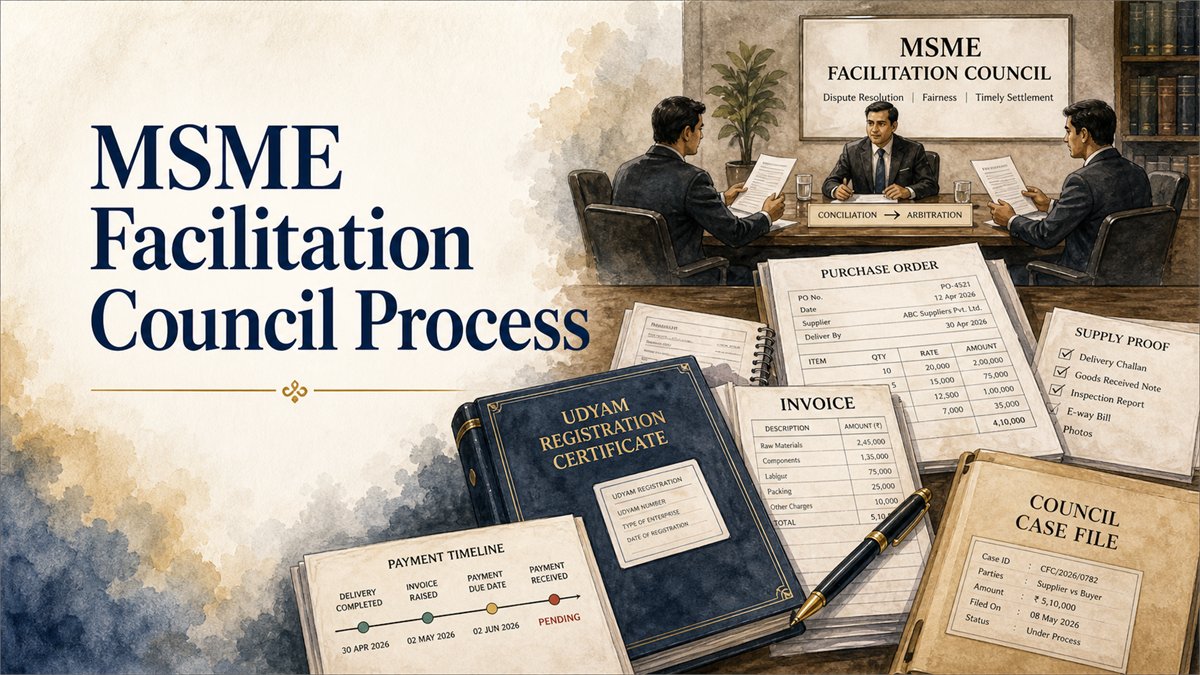
MSME limitation in one minute
- There is no universal rule that every MSME claim expires exactly three years from the invoice date.
- Many ordinary claims for goods, work or contractual payment do carry a three-year limitation period, but the starting date varies under the Limitation Act.
- For goods sold without fixed credit, Article 14 generally runs from delivery; with fixed credit, Article 15 generally runs when that credit period expires.
- For work done with no fixed payment time, Article 18 generally runs from completion of the work. Other contractual disputes may fall under different Schedule articles.
- Under Sonali Power Equipments (2025), the Limitation Act does not apply to Section 18(2) conciliation, so even a time-barred debt may be discussed and settled there.
- The Limitation Act does apply when the dispute proceeds to arbitration under Section 18(3).
- A timely written acknowledgment, qualifying part-payment or other statutory exclusion may materially change the limitation calculation.
Is the MSME limitation period always three years?
Three years is a common period for commercial money claims, but saying "three years from invoice date" without identifying the applicable Limitation Act entry can be wrong.
The Limitation Act contains different Schedule articles for different causes of action. For example, Article 14 covers the price of goods sold and delivered where no fixed credit period is agreed; Article 15 deals with goods sold on fixed credit; Article 18 deals with the price of work done where no payment time is fixed; and Article 55 covers compensation for breach of contract where no more specific article applies.
The correct exercise is therefore: identify the legal nature of the claim, identify the applicable Schedule article, identify the starting date under that article, and then test acknowledgments, payments, exclusions and other legally relevant events.
Examples of different three-year starting points
| Type of claim | Indicative Limitation Act provision | General starting point |
|---|---|---|
| Price of goods sold and delivered, no fixed credit | Article 14 | Date of delivery |
| Price of goods sold on a fixed credit period | Article 15 | When the agreed credit period expires |
| Price of work done, with no fixed payment time | Article 18 | When the work is done |
| Contractual compensation not specially provided elsewhere | Article 55 | When the relevant breach occurs, subject to the article's rules for successive or continuing breach |
These examples show why a single invoice-date formula is unsafe. The contract, purchase order, delivery record, service-completion record and agreed credit terms may move the legally relevant starting point.
How Section 15 MSMED payment dates fit into limitation
Section 15 of the MSMED Act determines when a buyer is required to make payment for the purpose of the MSMED delayed-payment regime. Where a written payment date is agreed, it is subject to the statutory ceiling; where there is no written payment date, the appointed-day mechanism becomes relevant.
That payment analysis is important to the chronology, but it should not be converted into an automatic statement that limitation in every possible MSME claim starts on one universal Section 15 date. The Supreme Court in Sonali Power expressly confined itself to the conciliation/arbitration limitation issues and did not decide the general question of commencement of limitation for every transaction.
For a limitation opinion, the Section 15 due-date chart and the applicable Limitation Act Schedule article should therefore be examined together rather than substituted for one another.
What did the Supreme Court decide in Sonali Power Equipments?
In M/s Sonali Power Equipments Pvt. Ltd. v. Chairman, Maharashtra State Electricity Board, 2025 INSC 864, the Supreme Court separated two stages of the Section 18 process.
First, it held that the Limitation Act does not apply to conciliation under Section 18(2). A debt does not disappear merely because the legal remedy for enforcing it has become time-barred. The parties may still voluntarily settle that debt through the conciliatory process.
Second, the Court held that the Limitation Act applies when conciliation fails and the matter proceeds to arbitration under Section 18(3). Section 43 of the Arbitration and Conciliation Act is attracted through the statutory framework.
This distinction is the central rule for current MSME limitation analysis.
Can a time-barred MSME claim still go to conciliation?
Yes. Sonali Power holds that a time-barred claim is not excluded from Section 18(2) conciliation. The supplier's underlying right to payment may subsist even though an adjudicatory remedy is barred by limitation.
This does not mean that conciliation automatically revives the claim for arbitration. It means the parties may use the voluntary settlement process to resolve an old debt. If settlement is reached, its legal effect comes from the settlement framework and the parties' agreement.
A supplier with old invoices should therefore distinguish two questions: Can the debt still be discussed and settled? and Can it still be adjudicated and awarded if conciliation fails? The answers can be different.
What happens if conciliation fails and the claim goes to arbitration?
Once the dispute enters Section 18(3) arbitration, limitation becomes an adjudicatory defence. The tribunal or Council must examine whether the claim is within limitation after applying the relevant Limitation Act provisions.
A claim that was already barred does not become timely merely because the Council first conducted conciliation. Equally, an apparently old invoice may still be within limitation if the correct starting date is later than assumed, or if a legally valid acknowledgment, part-payment or exclusion affects the calculation.
This is why both supplier and buyer should prepare an invoice-wise limitation schedule before the arbitral stage rather than arguing only from the age of the ledger.
When exactly does limitation start for an MSME claim?
There is no one answer for every transaction. Sonali Power expressly noted that broader questions such as commencement and extension of limitation did not generally arise for decision in those appeals.
For goods, the distinction between immediate payment and fixed credit can matter. For services or works, the completion date and agreed payment terms may matter. A milestone contract, running account, retained amount, disputed certification or successive breach can require a different analysis from a simple one-off sale.
Do not assume that the date of the legal notice, demand reminder, MSME Samadhaan filing or MSEFC hearing automatically becomes the cause-of-action date. Each event must be tested against the contract and the applicable Limitation Act provision.
Should multiple invoices be calculated separately?
Usually, an invoice-wise limitation chart is the safest starting point. Different invoices may have different delivery dates, credit periods, completion dates, part-payments, admissions and disputes.
A running business relationship does not automatically make every historical invoice timely merely because later invoices remain unpaid. Conversely, a genuine written reconciliation, account stated, acknowledgment or payment may change the position for particular liabilities.
The chart should record at least: invoice number, invoice date, delivery or completion date, written credit term, payment due date, part-payment, acknowledgment, buyer objection and the proposed limitation-expiry date with the legal basis used.
Can a written acknowledgment restart limitation?
Section 18 of the Limitation Act can start a fresh limitation period where, before expiry of the prescribed period, the debtor makes an acknowledgment of liability in writing and signs it, personally or through an authorised agent.
The document does not always need to contain the exact amount or an unconditional promise to pay. But the wording, signature, authority, timing and relationship to the liability must be examined carefully.
Examples that may require review include a signed balance confirmation, reconciliation statement, letter admitting dues, email carrying a legally attributable signature, or a formally adopted financial statement. A creditor's own reminder does not become an acknowledgment merely because it was sent to the buyer.
Does part-payment restart the limitation period?
Section 19 of the Limitation Act provides for a fresh period where qualifying payment on account of a debt is made before expiry of the prescribed period. The statutory proviso concerning acknowledgment of that payment in handwriting or signed writing must also be satisfied.
For MSME ledgers, do not record only the payment amount. Keep the bank entry, UTR/remittance record, buyer advice, ledger allocation and correspondence showing which invoice or liability the payment was meant to discharge.
Where one payment is made against several invoices, the appropriation of that payment may itself affect the limitation analysis and should not be assumed without checking the record.
Do Section 22 MSMED balance-sheet disclosures extend limitation?
Not automatically. Section 22 requires specified buyers to disclose certain unpaid MSME amounts and interest in their annual accounts. In Sonali Power, the Supreme Court considered whether those financial statements could amount to an acknowledgment under Section 18 of the Limitation Act.
The Court reiterated that a balance-sheet entry can amount to an acknowledgment, but the document must be read as a whole. Notes to accounts, auditor qualifications or explanatory statements may show that the entry is disputed or does not amount to an acknowledgment of liability.
The Supreme Court therefore said the effect of Section 22 disclosure must be examined case by case. Neither supplier nor buyer should rely on a balance-sheet figure without obtaining the complete financial statement and accompanying notes.
Can a time-barred debt still be promised or settled later?
Yes, in appropriate circumstances. Section 25(3) of the Indian Contract Act recognises a written and signed promise to pay wholly or partly a debt that could have been enforced but for limitation. Such a promise can itself constitute a contract.
This is different from a pre-expiry acknowledgment under Section 18 of the Limitation Act. Acknowledgment analysis asks whether a fresh limitation period began before the original period expired; Section 25(3) addresses a written promise concerning a debt already barred.
This distinction also helps explain why an old debt may still be capable of voluntary settlement even though compulsory arbitral enforcement is subject to limitation.
Does statutory interest under Section 16 create a new limitation period every month?
Do not assume so. Section 16 creates a strong statutory interest consequence for delayed payment, but the existence of continuing interest does not by itself justify treating the principal recovery claim as indefinitely alive.
The limitation analysis should start with the underlying liability and the applicable Limitation Act provision, then separately calculate statutory interest for the period legally recoverable. A monthly interest calculation is not a substitute for deciding whether the underlying arbitral claim is within time.
Does filing before MSEFC automatically stop limitation?
This question should be handled carefully rather than by a blanket website rule. The Arbitration and Conciliation Act applies limitation principles to arbitration, and Section 43(2) links arbitral commencement to the statutory commencement mechanism. MSMED proceedings also have their own Section 18 structure.
Sonali Power did not decide a universal commencement-date formula for all Section 18 claims. Therefore, a business should not assume that the date of an online application, administrative registration, first conciliation notice and commencement of arbitration are legally interchangeable.
The practical advice is simpler: do not wait for the last possible day. If limitation may be approaching, obtain a date-specific review before relying on an MSEFC filing event to save the claim.
Supplier-side limitation checklist
- Separate every material invoice or contractual milestone.
- Record delivery, service-completion and acceptance dates.
- Identify the written credit/payment period, if any.
- Match the transaction to the relevant Limitation Act Schedule article.
- Calculate the initial expiry date provisionally.
- Collect every buyer acknowledgment before that expiry date.
- Map every part-payment to the invoice or liability it relates to.
- Obtain full balance sheets and notes where Section 22 disclosures are relied on.
- Separate a possible conciliation settlement from arbitral enforceability.
- Do not assume a reminder notice, continuing interest or later invoice automatically revives an old claim.
Buyer-side limitation checklist
- Do not plead "three years from invoice date" without identifying the correct Schedule article.
- Check agreed credit terms, acceptance, completion and breach dates.
- Review whether any authorised employee admitted liability in writing.
- Check remittance records and invoice allocation for part-payments.
- Read financial-statement disclosures together with notes and auditor qualifications.
- Separate amounts genuinely time-barred from later invoices that may still be live.
- Raise limitation clearly at the arbitral stage with an invoice-wise calculation.
- Remember that an old debt may still be discussed in conciliation even where arbitral enforcement is disputed.
Current Section 18 wording: conciliation, mediation and the 2026 amendment
Current-status caution as of 4 October 2026: Section 62 and the Seventh Schedule of the Mediation Act, 2023 contain a future substitution of MSMED Section 18 using mediation terminology. However, the Central Government's commencement notification S.O. 4384(E) dated 9 October 2023 brought specified provisions into force and did not include Section 62.
The MSMED (Amendment) Act, 2026 has also received Presidential assent, but its own commencement clause permits the Central Government to appoint date or dates for its provisions through Gazette notification. The official materials checked for this review did not establish commencement of the relevant substituted Section 18 changes.
For that reason, this article describes the presently operative Section 18(2) conciliation and Section 18(3) arbitration framework applied by the Supreme Court in Sonali Power. The commencement position should be checked again before relying on this terminology in a live matter.
Bihar and Delhi MSME claims: does limitation change by State?
The Limitation Act and the central MSMED framework discussed above do not create a different basic limitation period merely because the supplier is in Bihar or Delhi. The commercial documents and procedural forum still matter.
For a Bihar or Delhi matter, the correct MSEFC, supplier location, registration record, invoices, contractual terms and current proceeding stage should be identified separately. See the regional pages for MSME recovery in Bihar, MSME recovery in Patna and MSME recovery in Delhi NCR.
Frequently asked questions
What is the limitation period for an MSME delayed-payment claim?
Many ordinary goods, work and contract claims carry a three-year period, but the starting date depends on the applicable Limitation Act provision. There is no safe universal rule of "three years from every invoice date."
Can an old or time-barred MSME claim still be filed for conciliation?
Sonali Power holds that the Limitation Act does not apply to Section 18(2) conciliation and a time-barred debt can still be referred for possible settlement.
Can the same time-barred claim be awarded in Section 18(3) arbitration?
The Limitation Act applies at the arbitral stage. Whether the particular claim is barred must be calculated after considering the applicable Schedule article and legally effective acknowledgments, payments or exclusions.
Does sending repeated payment reminders extend limitation?
Not by itself. A creditor's reminder is not the debtor's acknowledgment. What matters is whether there is a legally qualifying event such as a timely written signed acknowledgment or qualifying part-payment.
Does a buyer email admitting dues extend limitation?
It may, depending on timing, wording, attribution, signature requirements and authority. The actual email and surrounding record should be examined under Section 18 of the Limitation Act rather than assuming every email qualifies.
Does the buyer's balance sheet automatically save limitation?
No. The Supreme Court says the balance-sheet entry, notes and auditor material must be examined case by case to determine whether there is a valid acknowledgment.
Can a debt already barred by limitation be settled?
Yes. It may be voluntarily settled, and Section 25(3) of the Contract Act also recognises an enforceable written and signed promise to pay a time-barred debt, subject to its requirements.
Conclusion
MSME limitation should be calculated from documents, not slogans. Three years is common, but the correct starting date may depend on delivery, agreed credit, completion of work, breach and the specific Limitation Act entry. Each invoice or milestone may require separate analysis.
The Supreme Court's 2025 Sonali Power decision adds an important procedural distinction: a time-barred debt may still be taken into Section 18(2) conciliation for a possible settlement, while the Limitation Act governs the adjudicatory Section 18(3) arbitration stage. Acknowledgments, part-payments and Section 22 financial disclosures can change the result, but only after their legal requirements and timing are checked.
Last updated on: 04/10/2026 at 21:08
Useful Internal Pages
References / Sources
- M/s Sonali Power Equipments Pvt. Ltd. v. Chairman, Maharashtra State Electricity Board & Ors., 2025 INSC 864, Supreme Court, 17 July 2025.
- Limitation Act, 1963 - India Code, including Sections 18 and 19 and the Schedule.
- Micro, Small and Medium Enterprises Development Act, 2006 - India Code.
- Arbitration and Conciliation Act, 1996 - India Code, including Section 43.
- Indian Contract Act, 1872 - India Code, Section 25(3).
- S.O. 4384(E), 9 October 2023 - commencement notification under the Mediation Act, 2023.
- Ministry of MSME - Orders and Notices, including the MSMED (Amendment) Act, 2026.