The most consequential decision in a delayed-possession file is whether the allottee wants to leave the project or still wants the unit. Section 18(1) provides refund with prescribed interest where the statutory conditions are met and the allottee withdraws; its proviso provides delay interest where the allottee remains. The correct choice requires a complete review of the agreement, actual payments, possession offer, approvals, loan obligations and any settlement—not a calculation from the promised date alone.
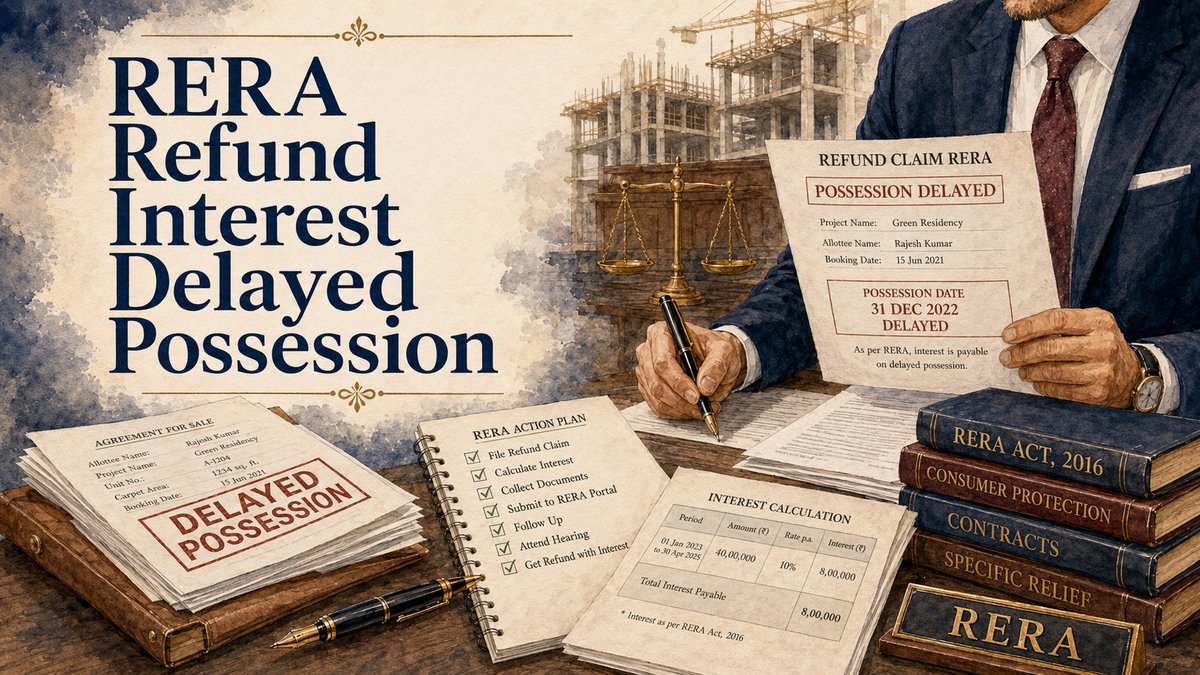
The decision in one minute
- Refund and exit: when Section 18 is attracted and the allottee elects to withdraw, seek the amount received by the promoter with interest at the State-prescribed rate, with separate compensation where maintainable.
- Retain the unit: where the allottee does not withdraw, seek interest for every month of delay until handover of possession, at the prescribed rate, along with appropriate possession-related directions.
- First verify: agreement deadline, grace period, extensions, allottee payment defaults, occupation/completion certification, offer terms and any accepted revised arrangement.
- Do not mix outcomes: unconditional exit and continued ownership are different final remedies. If alternative prayers are used, make their sequence and conditions express.
Section 18: two paths, one statutory framework
Section 18(1) of the Real Estate (Regulation and Development) Act, 2016 addresses failure to complete or give possession in accordance with the agreement for sale, and specified discontinuance of the promoter's business. When those conditions are satisfied and the allottee withdraws, the promoter must return the amount received with prescribed interest. The proviso addresses allottees who remain and receive prescribed interest for each month of delay until possession is handed over.
The Supreme Court in Newtech Promoters and Developers Pvt. Ltd. v. State of Uttar Pradesh described the qualifying allottee's refund election as a statutory right. That does not eliminate examination of contractual dates, legally material defaults or the facts of the individual project.
Side-by-side comparison before choosing relief
| Question | Refund / withdraw | Possession / stay |
|---|---|---|
| Desired result | End the allotment and recover amounts paid | Keep the unit and obtain lawful possession |
| Section 18 route | Section 18(1), where triggered | Proviso to Section 18(1) |
| Core money claim | Receipts/amount paid with prescribed refund interest | Prescribed delay interest pending possession |
| Key record | Payment trail, deadline, election, cancellation/settlement, lender position | Deadline, OC/CC, offer of possession, physical readiness, outstanding charges |
| Continuing exposure | Refund execution and loan closure/security discharge | Future instalments, registration, maintenance, defects, handover |
| Separate claim | Compensation requires its own pleadings and adjudicatory route | Compensation also requires its own basis and route |
Start with the agreement's possession clause
Read the complete agreement for sale, including the construction-period trigger, promised handover date, any grace period and conditions to invoking it. Identify the exact clause and calculate the date in a worksheet. A booking form, brochure, project launch date and RERA registration completion date are different records and should not silently replace the agreement date.
Review each later signed amendment and whether the allottee actually agreed to a revised possession deadline. A unilateral expectation email or marketing assurance should be described for what it is.
Regulatory extension is a separate evidence question
Collect any extension of project registration, the Authority's order and the promoter's claimed cause of delay. The existence of a revised project completion date on a portal does not, without more, answer the allottee's contractual Section 18 entitlement. Analyse the precise order, applicable law, buyer agreement and relevant judicial directions together.
Similarly, force-majeure claims must be linked to an actual event, its duration and its effect on development; a boilerplate clause should not be accepted as conclusive proof.
Review the purchaser's payment obligations
The choice can be affected by a genuine and material allottee default. Compare each demand letter and contractual milestone with receipts, bank transfers, lender disbursements and any dispute about unlawful or premature demand. Sections 19(6) and 19(7) address allottee payment obligations and prescribed interest for delay.
Do not assume that any late instalment automatically excuses the entire promoter delay, or that an admitted buyer default is irrelevant. Analyse chronology and causation.
Prepare two different financial schedules
For a refund path, prepare a payment-by-payment receipt chart and a prescribed-interest calculation up to a stated date, separately recording any refunds or adjustments already made. For a possession path, prepare the legally supported period of delay, amounts to which interest applies under the relevant rule and the status of any unpaid instalment or charge.
Neither schedule should use a national fixed interest rate. Apply the rate prescribed by the State/UT rules and the relevant period. See the Section 18 refund and interest guide.
Refund review: identify the money actually received
Reconcile booking money, instalments, taxes and other disputed components separately. Link every amount claimed to a receipt, bank debit, builder ledger, loan disbursement certificate or account statement. If money was paid by a co-allottee or loan provider on the allottee's behalf, explain its source and legal treatment.
Do not automatically describe refundable principal as the entire sale consideration when only part was paid.
Home loan and mortgage implications of refund
A bank-financed allottee should obtain the sanction letter, loan agreement, disbursement statement, current outstanding balance, security/mortgage details, repayment history and any tripartite arrangement with the builder. A refund may need to be routed or appropriated according to lender rights and any legally binding settlement or order.
Importantly, filing or obtaining a RERA refund order does not by itself close the borrower's loan. Continue to check EMI liability, lender communications, foreclosure/security release and treatment of disbursements made directly to the promoter.
Possession review: inspect the offer, not just its date
Collect the original possession offer, any amended offer, demand for final instalment, inspection notice, snag list, handover memorandum and correspondence. Check the relevant occupancy or completion certificate, building or phase it covers, its issuance date and the physical readiness of the particular unit.
Section 11(4)(b) places obligations on the promoter to obtain applicable certification. The Supreme Court in Parsvnath Developers Ltd. v. Mohit Khirbat (20 February 2026), in consumer proceedings, affirmed that lawful possession cannot be forced without the requisite occupancy certificate. The decision is relevant when assessing an offer but should not be mistaken for a universal RERA interest-rate ruling.
Physical readiness and lawful readiness are separate
A nearly completed flat can still raise certification, essential services, access or safety issues. Conversely, an issued certificate does not automatically prove every contractual specification was met. Record unit condition, water/electricity availability, access, promised amenities, sanctioned plans and any deviations.
Use dated photographs and inspection notes rather than a bare assertion that possession is or is not ready.
When the allottee already accepted possession
Review the possession memo, keys/handover date, conveyance deed, certificate, "full and final" wording, delay-interest waiver and any protest or reservation of rights. Acceptance can materially change available relief and the period for which interest is disputed, but the consequences depend on the actual document and law.
Do not mechanically demand a future refund for a unit already taken without reviewing the later relationship, payments and accepted settlement.
When the promoter offers an alternative unit
Compare the original allotment with the alternative offer: location, tower, area, specifications, price, amenities, delivery date and any adjustment. Record whether it was accepted and whether the allottee signed a substitution or settlement agreement.
An unsolicited alternative unit is not automatically a binding amendment to the original agreement.
Cancellation letters, refund promises and settlement deeds
Preserve all cancellation requests, promoter cancellation notices, refund assurances, instalment-refund schedules, settlement offers and any executed settlement deed. Distinguish proposals from accepted agreements. An executed settlement, release, novation or acknowledgment may affect the nature and quantum of the claim.
Any proposed exit should specify principal, interest, payee, payment deadline, loan discharge, cancellation documentation and the consequence of default. Do not surrender critical originals or security before understanding settlement conditions.
Delay-interest review when the allottee retains the flat
The proviso to Section 18(1) speaks of interest for every month of delay until handing over possession. Establish the correct start date under the agreement and applicable law, and assess the legally relevant end date by examining certification, a valid offer and actual handover.
Do not end interest automatically on the date a generic possession email was issued, or extend it indefinitely without analysing the buyer's conduct and actual readiness.
Refund interest needs payment dates and the prescribed rate
The Section 2(za) framework and relevant State rules must be reviewed to calculate interest. Maintain a separate row for every payment received by the promoter, each relevant starting date and the chosen calculation cut-off.
Record the source of the prescribed rate, any benchmark variations and assumptions; do not copy the rate from an unrelated State or a consumer-forum award.
Compensation is not the same as statutory interest
Claimed rent, relocation expenses, specific financial loss or other compensatory heads require a separate factual and legal basis. Section 72 sets factors for determination of compensation. In Newtech Promoters, the Supreme Court distinguished the Authority's adjudicatory power over refund and interest from the Adjudicating Officer's function of adjudging compensation under Sections 71 and 72.
A complaint seeking only refund and interest should not casually insert large unsupported "compensation" figures into the principal refund computation.
Check project status and pending orders
Preserve project registration status, quarterly updates, relevant extension orders, completion disclosures, promoter change/transfer orders and any insolvency or court restrictions that may bear on relief or enforcement. For an older project, retain documents predating RERA registration.
Even a legally strong refund entitlement requires realistic assessment of enforcement, existing creditors and any binding moratorium or restraint order.
Review earlier litigation or complaint proceedings
Ask whether the same allottee and unit are already the subject of a consumer case, RERA complaint, civil suit, arbitration, insolvency process or executed settlement. In Imperia Structures Ltd. v. Anil Patni, the Supreme Court recognised that the consumer remedy remains available alongside RERA for eligible consumers, but overlapping proceedings and double recovery require careful handling.
Documents to examine for the refund option
- Allotment letter, complete agreement and possession-date clause.
- Payment receipts, ledger, bank proofs and lender disbursements.
- Loan agreement, outstanding loan statement and mortgage/tripartite papers.
- Project status and promoter extension orders.
- Delay notices, refund demand, promoter replies and any cancellation.
- Refund worksheet showing principal, payment dates and interest to cut-off.
- Earlier settlements, signed releases or pending proceedings.
- Current promoter identity and details required for enforcement.
Documents to examine for the possession option
- Allotment letter, agreement, payment plan and possession clause.
- Builder demands and proof of amounts paid/outstanding.
- Registration/extension orders and construction updates.
- Occupancy/completion certificate, sanctioned plans and relevant approvals.
- Possession offer, inspection notes, snag list and handover documents.
- Evidence of essential services and promised amenities where disputed.
- Delay-interest schedule to the legally relevant cut-off/handover.
- Any waiver, settlement or reservation of rights signed at handover.
A single decision worksheet helps identify missing proof
| Review question | Evidence | Impact |
|---|---|---|
| Has agreed possession date passed? | Agreement, annexures, valid amendments | Core Section 18 trigger |
| Is promoter relying on extension? | Actual registration/force-majeure/order documents | Evaluate defence and period |
| Is buyer materially in default? | Demand-and-payment ledger | May affect entitlement/relief |
| Is lawful handover available? | OC/CC, offer, inspection, project status | Possession viability and interest period |
| What sum is paid and by whom? | Receipts, bank, lender disbursements | Refund computation and routing |
| What does buyer intend? | Signed instructions, prior notices/settlements | Primary relief and prayers |
| Any separate loss? | Actual rent/loan/other loss records | Compensation pleading and AO route |
How to frame the prayer after the election
Refund: identify the allotment, request return of proved payments and interest under the correct statutory rule, state a calculation cut-off and seek appropriate continuing relief. Plead compensation separately in the proper forum where maintainable.
Possession: seek compliance with the lawful possession obligation, necessary certification where applicable and prescribed delay interest until the legally relevant handover date. Identify any disputed final demand or outstanding amount rather than assuming all charges are void.
Where alternatives are procedurally permissible, plead them conditionally and coherently—not as two unconditional final outcomes to be granted together.
State-specific forms, fees and interest rules still govern
Section 31 provides the complaint mechanism, but forms, filing fees, required affidavits and portal routing differ by State/UT and by relief. The project-location Authority is usually the starting point for identifying the applicable regime.
For a Bihar matter, separately review the Bihar RERA complaint guide and Bihar delayed-possession page. No general percentage in this article substitutes for the applicable State rule.
What not to assume
- That a revised RERA completion date automatically amends the agreement.
- That an offer of possession is necessarily valid without certification.
- That a buyer who has accepted possession can always pursue an unconditional exit.
- That the lender will automatically cancel the loan upon a refund order.
- That contractual or consumer-award interest is always the prescribed RERA rate.
- That a settlement email is equivalent to an executed release.
- That compensation is simply an extra percentage added to refund interest.
- That duplicate proceedings can result in double recovery.
Frequently asked questions
When should a RERA allottee choose refund rather than possession?
A refund route deserves review where Section 18 conditions are met, possession is overdue, and the allottee wishes to withdraw from the project. The agreement, delay record, payments, lawful readiness and any settlement must be examined before election.
Can the allottee keep the flat and claim interest for delay?
Yes. The proviso to Section 18(1) provides interest at the prescribed rate for each month of delay until handover of possession where the allottee does not intend to withdraw.
Does a possession offer automatically defeat a refund claim?
No automatic rule applies. Review the offer date, certificate, contractual deadline, project readiness, communications and any accepted settlement. Prolonged delay and an offer without necessary statutory approvals are material.
What happens to a home loan if refund is elected?
The lender's disbursements, mortgage/security, repayment history, outstanding loan balance and refund-routing conditions must be reconciled. A RERA refund order does not automatically discharge the borrower's loan obligations.
Can the allottee claim compensation along with refund or delay interest?
Compensation is a distinct head requiring facts and supporting evidence. Newtech Promoters distinguishes regulatory authority powers over refund/interest from compensation adjudication by the adjudicating officer under Sections 71 and 72.
Is the RERA interest rate identical across India?
No. The applicable prescribed interest rate follows the rules for the relevant State or Union Territory and the period. Verify the current rule and benchmark instead of importing another State's rate.
Conclusion
A Section 18 election should follow the evidence. Refund requires a credible withdrawal position, complete payment and loan reconciliation, and an enforceable claim for return with prescribed interest. Retention requires a viable unit, proof of lawful possession readiness and a defensible delay-interest period. A separate compensation claim must be pleaded and supported on its own terms.
Choose the remedy only after comparing the agreement, approvals, payment record, possession offer, lender position, existing proceedings and the allottee's actual objective.
Last updated on: 08/10/2026 at 09:08
Useful Internal Pages
References / Sources
- Real Estate (Regulation and Development) Act, 2016, India Code (as updated 15 May 2026), Sections 2(za), 11, 18, 19, 31, 71 and 72.
- Newtech Promoters and Developers Pvt. Ltd. v. State of Uttar Pradesh, Supreme Court, 11 November 2021.
- Parsvnath Developers Ltd. v. Mohit Khirbat, Supreme Court, 20 February 2026 (consumer proceeding; occupancy certificate and lawful possession).
- Ireo Grace Realtech Pvt. Ltd. v. Abhishek Khanna, Supreme Court, 11 January 2021 (delay and possession-offer analysis).
- Imperia Structures Ltd. v. Anil Patni, Supreme Court, 2 November 2020 (consumer and RERA remedies).