A delayed-possession complaint should be prepared around a verified timeline, not a general allegation that the project is late. The file should establish the contractual possession date, grace period, any amendment or regulatory extension, allottee payment compliance, present project/occupancy status, validity of any possession offer and a clear election between withdrawal with refund or continued possession with delay interest. Compensation is a separate head that needs its own factual basis.
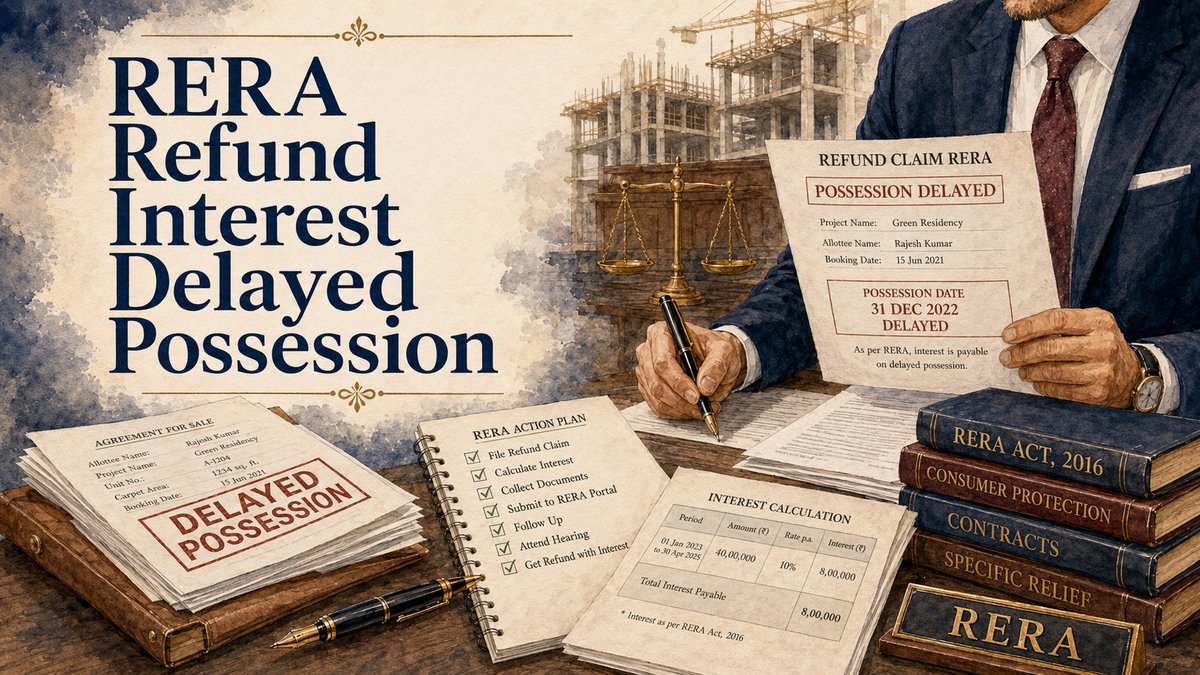
Delayed-possession complaint checklist in one minute
- Identify the exact project, promoter, unit and RERA registration number.
- Fix the possession date from the agreement for sale.
- Separate contractual grace period from later informal assurances.
- Collect every RERA project-registration extension/order relied on by the promoter.
- Reconcile the allottee's payments and any genuine payment default.
- Check construction status and whether completion/occupancy certificate exists.
- Examine any possession offer for legal and factual readiness.
- Choose the primary Section 18 relief: refund and exit or continue with the unit and claim delay interest.
- Identify any separate compensation claim and its supporting proof.
- Prepare a dated chronology and indexed annexure set before drafting the complaint.
Step 1: identify the correct project and promoter
Start with the registered project name, registration number, phase, promoter entity and unit details. Large developments may have multiple phases or promoter entities with similar marketing names.
Match the agreement, allotment letter, payment receipts and RERA portal record. A complaint against the wrong company or wrong project phase creates an avoidable maintainability and execution problem.
Step 2: fix the contractual possession date
The central Section 18 question is whether the promoter failed to complete or give possession in accordance with the agreement for sale or by the date specified there.
Extract the exact possession clause. Record the base construction period, trigger date, contractual grace period and any condition precedent expressly tied to commencement of that period.
Do not use a brochure estimate or a later sales email as a substitute for the agreement unless it legally modifies the contractual timeline.
Prepare a possession-date worksheet
| Field | What to record |
|---|---|
| Agreement date | Date the agreement for sale / builder-buyer agreement was executed. |
| Possession clause | Exact clause number and wording. |
| Trigger event | Agreement date, plan approval, commencement, fire NOC or other stated trigger. |
| Base period | Months/years promised for completion. |
| Grace period | Any contractual additional period and its conditions. |
| Calculated due date | Date after applying the proved trigger and valid contractual period. |
| Later amendment | Any signed supplementary agreement or accepted revised timeline. |
| RERA extension | Separate regulatory extension/order, if any. |
Project registration date is not automatically the buyer's possession date
The project's declared completion date on the RERA portal is important evidence, but the allottee's Section 18 claim is ordinarily anchored to the agreement for sale.
Collect both dates and explain any difference. Do not silently replace the contractual possession date with the regulatory registration date merely because the latter is later.
Step 3: examine every claimed extension
A promoter may rely on a contractual grace period, supplementary agreement, RERA registration extension, force majeure or a regulatory/court order.
List each claimed extension separately with its legal source, start date, end date and actual impact on the project. Avoid accepting a generic statement that "RERA extended the project" without the underlying order.
Force majeure should be proved, not merely pleaded
Section 6 defines force majeure for project-registration extension by reference to war, flood, drought, fire, cyclone, earthquake or another calamity caused by nature affecting regular development of the project.
The Bombay High Court in 2026 has cautioned against treating overbroad contractual events as if they automatically fit the statutory force-majeure definition.
For any force-majeure defence, collect the actual event, dates, government orders where relevant, extension order and evidence linking the event to the period of delay claimed.
Step 4: reconcile the allottee's payment record
The promoter may contend that possession was delayed because the allottee defaulted. Prepare a complete payment schedule before filing.
| Payment field | Record |
|---|---|
| Demand date | Builder demand / milestone demand. |
| Amount demanded | Base demand plus taxes/charges separately. |
| Due date | Contractual due date. |
| Amount paid | Actual amount remitted. |
| Payment date | Bank/receipt date. |
| Proof | Receipt, bank statement, UTR or loan-disbursement record. |
| Disputed charge | Any amount withheld with reason. |
If there was a genuine allottee default, address it candidly and analyse whether it actually caused or legally affected the promoter's possession obligation.
Step 5: collect the project-status record
Download or preserve the current project page from the relevant RERA portal. Record registration status, revised completion date, quarterly progress, approvals and any uploaded extension/order.
Also preserve dated site photographs, construction updates and communications. The complaint should be able to show the project status both at the contractual due date and at filing.
Step 6: verify completion and occupancy certificates
Section 11(4)(b) makes the promoter responsible for obtaining the completion certificate or occupancy certificate, as applicable, from the competent authority and making it available to allottees.
Do not treat a possession email or demand for final payment as proof that lawful possession was available. Obtain and verify the certificate relevant under the local law and the particular project.
Step 7: test any offer of possession
If possession has been offered, record the offer date, certificate date, demands attached to the offer, unit readiness, amenities, snag/inspection record and whether actual handover was possible.
An offer issued long after the contractual date may affect the relief analysis, but it does not erase the historical delay. Supreme Court authority recognises that an allottee cannot always be forced to accept possession after an unreasonable or indefinite delay.
Refund or possession: make the Section 18 election clearly
Section 18 creates two materially different paths.
Allottee withdraws: claim return of amounts received by the promoter with prescribed interest, together with any legally maintainable compensation.
Allottee stays in the project: claim prescribed interest for every month of delay until possession is handed over.
The Supreme Court in Newtech Promoters described the refund entitlement, once the statutory conditions are met and the allottee elects to withdraw, as an unqualified right.
Do not draft refund and possession as if both are simultaneous final outcomes
A complaint can frame alternative relief where procedurally appropriate, but it should identify the allottee's actual primary election.
Seeking unconditional refund while simultaneously asking the Authority to compel possession can create ambiguity. Draft the principal and alternative prayers deliberately.
Step 8: calculate refund interest under the correct State rule
RERA does not impose one permanent nationwide percentage. The rate is prescribed under the relevant State/Union Territory rules and may be linked to an external benchmark.
Identify the rule, benchmark, relevant dates and payment-by-payment calculation. Do not copy an interest rate from an order in another State.
Step 9: calculate delay interest if the allottee stays
Where the allottee does not withdraw, the proviso to Section 18(1) provides interest for every month of delay until handing over of possession.
Prepare a payment-wise schedule if the State formula applies interest to amounts paid over different dates, and identify the legally relevant start/end period under the applicable rules and authority precedent.
Refund, interest and compensation are different heads
Refund returns the money paid. Statutory interest compensates for the delayed use/return of money under the prescribed RERA framework. Compensation is a separate statutory head requiring adjudication and a factual basis.
Do not put mental agony, rent, loan burden, escalation and every other asserted loss into the refund figure itself.
Authority versus Adjudicating Officer
The Supreme Court in Newtech Promoters clarified the institutional division. Refund of the amount and interest under Section 18 are within the adjudicatory power of the Regulatory Authority, whereas compensation under Sections 12, 14, 18 and 19 is adjudged by the Adjudicating Officer under Section 71.
State portals may use separate complaint forms/routes. Select the correct relief and forum at the filing stage rather than asking one authority for every conceivable remedy.
Step 10: build the compensation file separately
If compensation is claimed, identify each loss and supporting evidence: rent paid because of delay, additional financing cost, specific relocation expense, proven business/other loss where legally recoverable, or another statutory injury.
Section 72 directs the Adjudicating Officer to consider factors including disproportionate gain/unfair advantage, loss caused, repetitive default and other factors necessary for justice.
Step 11: prepare the chronology
A practical chronology should include:
- Booking/application date.
- Allotment date.
- Agreement execution.
- Material payment dates.
- Possession trigger event.
- Contractual due date and grace-period end.
- RERA registration and extension dates.
- Promoter assurances/revised dates.
- Allottee notices or site visits.
- Completion/occupancy certificate date, if any.
- Possession offer date, if any.
- Refund/possession election and demand.
- Latest promoter response.
Step 12: organise the annexures
- Booking application and receipt.
- Allotment letter.
- Agreement for sale / builder-buyer agreement.
- Payment plan and demand letters.
- Receipts, bank statements and loan-disbursement records.
- RERA project registration page and extension orders.
- Construction updates and site photographs.
- Emails/letters/WhatsApp communications relied upon.
- Completion/occupancy certificate.
- Possession offer and attached demands.
- Legal notice/refund demand and reply.
- Interest worksheet.
- Compensation evidence, where claimed.
- Earlier case/settlement/arbitration/consumer proceedings.
Step 13: check promoter's likely defences before filing
- Allottee payment default.
- Contractual grace period.
- Force majeure.
- RERA extension order.
- Government/authority delay.
- Possession already validly offered.
- Occupation/completion certificate obtained.
- Allottee accepted revised schedule.
- Cancellation or settlement.
- Complaint before another forum.
- Wrong promoter/project/phase impleaded.
RERA extension and buyer agreement should be pleaded separately
If the promoter relies on an extension of project registration, annex the extension order and explain its legal relevance to the buyer's contractual possession date.
Do not assume either extreme—that every regulatory extension automatically defeats the buyer's Section 18 right, or that every extension is irrelevant. The facts, order and contract have to be analysed together.
Check whether the project was already delayed before RERA registration
Older projects may have contractual possession dates that expired before registration under the 2016 Act. Supreme Court authority such as Imperia Structures has dealt with projects where the promised completion period expired before later RERA registration.
Collect the entire pre-RERA agreement and payment history rather than limiting the complaint to portal data created later.
Concurrent consumer remedy should be disclosed
The Supreme Court in Imperia Structures held that RERA does not bar consumer-forum remedies. The remedies are additional/concurrent for an allottee who qualifies under consumer law.
That does not justify double recovery. If another proceeding exists, disclose it and frame relief consistently.
Check arbitration clauses but do not assume they oust RERA
A builder-buyer agreement may contain an arbitration clause. That clause does not automatically remove the statutory RERA jurisdiction.
Record any arbitration notice or pending arbitration separately because parallel proceedings and overlapping relief require case-specific analysis.
Complaint form, fee and portal are State-specific
Section 31 creates the complaint right, but the prescribed form, fee, online filing process and routing between the Authority and Adjudicating Officer depend on the State/Union Territory rules and live portal.
Check the project-location RERA immediately before filing rather than using a form from another State.
Bihar delayed-possession files
For Bihar projects, the complaint should additionally be checked against the current Bihar RERA portal, Bihar Rules and present form/fee/routing instructions. Existing Bihar RERA decisions commonly apply the State's prescribed interest rule to delayed-possession/refund relief.
See the Bihar delayed-possession guide and Bihar RERA complaint preparation guide.
Final pre-filing audit
| Question | Must be clear before filing |
|---|---|
| Who is the promoter? | Correct legal entity and project/phase. |
| When was possession due? | Contractual calculation with grace/trigger proved. |
| Was the allottee in payment default? | Complete reconciliation. |
| What extension is relied on? | Actual order/document, not assertion. |
| Is there OC/CC? | Certificate and date verified. |
| Was possession validly offered? | Offer, readiness, certificate and demands checked. |
| What does allottee want? | Refund/exit or possession with delay interest. |
| Is compensation claimed? | Separate factual and documentary basis. |
| Which forum/form? | Authority/AO and State-specific filing route checked. |
| Any parallel case? | Consumer/arbitration/civil/earlier RERA proceeding disclosed. |
Common delayed-possession complaint mistakes
- Using a guessed possession date instead of calculating the agreement clause.
- Ignoring the grace period without analysing whether it applies.
- Ignoring a RERA extension order or assuming it automatically defeats the complaint.
- Failing to reconcile allottee payment defaults.
- Claiming refund and possession as simultaneous final reliefs without an alternative structure.
- Copying an interest rate from another State.
- Seeking compensation without supporting loss evidence.
- Filing before the wrong branch—Authority versus Adjudicating Officer.
- Calling an offer "invalid" without checking occupancy/completion certificate and actual readiness.
- Omitting existing consumer, arbitration, civil or prior RERA proceedings.
- Uploading one unindexed PDF with no chronology.
Frequently asked questions
Can the builder force me to wait because construction is still progressing?
Not indefinitely. Section 18 and Supreme Court authority recognise an allottee's right to withdraw and seek refund where the statutory conditions are met, subject to the complete agreement and factual record.
Can I stay in the project and still claim interest?
Yes. The proviso to Section 18(1) provides prescribed interest for every month of delay until possession is handed over where the allottee does not withdraw.
Is the RERA registration completion date more important than my agreement?
Both are relevant but serve different functions. The Section 18 complaint should identify the contractual possession date and separately address any project-registration extension or revised regulatory completion date.
What if possession was offered but the occupancy certificate was not available?
Section 11 makes the promoter responsible for obtaining the applicable occupancy/completion certificate. The complaint should verify the certificate and local-law readiness of possession before accepting the offer as legally complete.
Can I claim rent and mental agony?
Those are not automatically part of refund or delay interest. A compensation claim requires the proper adjudicatory route and factual proof of the loss claimed.
Can I also file before the Consumer Commission?
RERA does not by itself bar the additional consumer remedy where the allottee qualifies as a consumer. Existing or parallel proceedings should be disclosed and double recovery avoided.
Conclusion
A delayed-possession complaint is strongest when the legal relief follows a verified chronology. The agreement should fix the due date; the project record should test extensions and completion status; the payment schedule should answer allottee-default allegations; and the possession record should show whether a lawful handover was ever available.
Only after those issues are settled should the complaint choose refund, continued possession with delay interest, compensation or properly structured alternative relief.
Last updated on: 06/10/2026 at 22:32
Useful Internal Pages
References / Sources
- Real Estate (Regulation and Development) Act, 2016 - India Code, including Sections 6, 11, 18, 31, 71 and 72.
- Newtech Promoters and Developers Pvt. Ltd. v. State of Uttar Pradesh, Supreme Court, 11 November 2021 - Section 18 refund/interest and Authority/AO jurisdiction.
- Imperia Structures Ltd. v. Anil Patni, Supreme Court, 2 November 2020 - concurrent consumer and RERA remedies.
- Ireo Grace Realtech Pvt. Ltd. v. Abhishek Khanna, Supreme Court, 11 January 2021 - prolonged delay, possession and refund principles.
- Rare Township Pvt. Ltd. v. Saji Mathews, Bombay High Court, 15 April 2026 - statutory force-majeure definition and overbroad contractual clauses.