Before filing a RERA complaint, the agreement should be marked clause by clause. A useful pleading identifies the exact contractual promise, the applicable statutory provision, the event that allegedly breached the promise, proof of the breach, and the relief the chosen forum can grant. Possession, payment demands, cancellation, unilateral changes, interest, and statutory waivers need particular scrutiny.
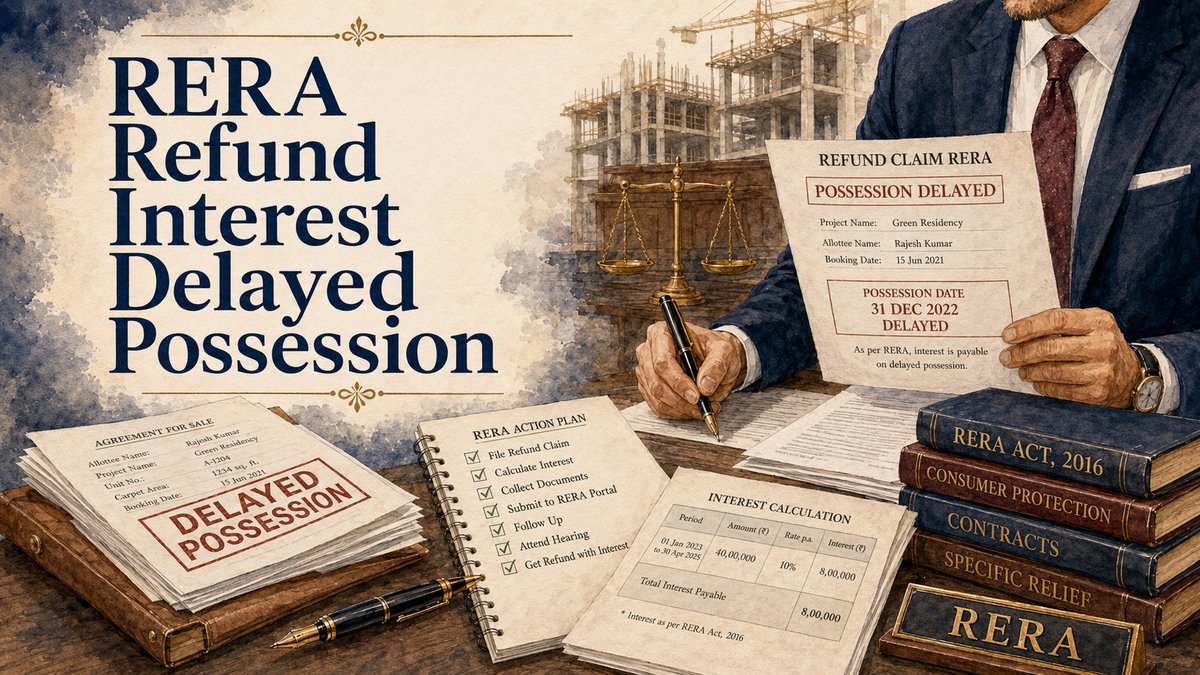
How to review the agreement
- Identify the buyer, promoter, unit, phase and project registration.
- Collect the signed agreement and every referenced schedule or amendment.
- Record the exact clause and any connected statutory protection.
- Compare payment, construction, plan and possession documents against the promise.
- Decide whether the supported relief is refund, possession, interest, compliance, cancellation challenge or separately adjudged compensation.
- Use one clause-to-evidence matrix before drafting facts or prayers.
The agreement is one part of the evidence record
Obtain booking forms, allotment letters, the full registered agreement for sale, incorporated plans, specifications, payment schedules, marketing representations relied upon, bank receipts, lender disbursements, regulatory project disclosures and signed variations. Identify the applicable State-prescribed model agreement and rules. A brochure or verbal promise must be evaluated as evidence—not silently substituted for a signed contractual term.
What courts say about one-sided clauses
In Pioneer Urban Land & Infrastructure Ltd. v. Govindan Raghavan and Ireo Grace Realtech Pvt. Ltd. v. Abhishek Khanna, the Supreme Court criticised oppressive and one-sided standard-form builder agreements in the consumer-law setting. The point is not that every buyer-unfavourable term is void; each objection needs the clause, relevant statutory or legal test, actual prejudice and a forum empowered to grant the requested relief.
Clause 1: Promoter identity, unit and project phase
Check the exact legal entity, project-registration number, phase, tower, floor, unit and co-allottee details against the RERA project record. A marketing name or group-brand name is not necessarily the contracting promoter.
Document check: Agreement cover, allotment letter, RERA portal record, company documents. Issue: Correct respondent, project and enforceability.
Clause 2: Booking money and the Section 13 ten-per-cent rule
Under Section 13(1), a promoter must not accept more than 10% of the cost before entering into and registering a written agreement for sale. Test when cumulative money exceeded the threshold; do not treat a Section 13 breach as automatic proof of every other remedy.
Document check: Application, receipts, total cost sheet, execution and registration date. Issue: Statutory agreement/advance compliance.
Clause 3: Agreement form and incorporated schedules
Section 13(2) calls for the prescribed form and specified development details, payment schedule, possession date and default-interest rates. Check that every annexure actually exists and is signed or otherwise properly incorporated.
Document check: Complete agreement, annexures, registration record, prescribed State form. Issue: Missing terms, inconsistent disclosures.
Clause 4: Price, carpet area and measurement basis
Distinguish carpet area under Section 2(k) from super/built-up or marketing area. Identify the agreed area, adjustment formula and any revised measurement. Test alleged shortfall against plans and objective measurement rather than guesswork.
Document check: Price sheet, floor plan, approved drawing, area statement. Issue: Area/price variation objection.
Clause 5: Additional charges, tax and development levies
Separate the basic unit price from taxes, parking, preferential location, infrastructure, club, electricity and maintenance demands. Match each component to the contract, disclosed formula, triggering event and governing law.
Document check: Demand notices, charge schedules, invoices and regulations. Issue: Unauthorised or premature charges.
Clause 6: Construction-linked instalments
Check whether a demand is based on a fixed date or a construction milestone. A buyer may be liable for valid payments under Sections 19(6)–(7), but the promoter should support a disputed milestone demand.
Document check: Payment schedule, engineer/site evidence, demands, receipts. Issue: Payment default or wrongful demand.
Clause 7: Possession deadline and trigger
Identify the exact start event: agreement, plan sanction, commencement, fire approval or other defined trigger. Calculate the deadline from the proved event. Do not substitute a later portal completion date for the agreed date without analysis.
Document check: Agreement clause, approval/commencement records, date worksheet. Issue: Section 18 delayed-possession claim.
Clause 8: Grace period and extension language
Identify the number of additional months, conditions, notice requirements and claimed causes. Distinguish a signed amendment, project-registration extension order and unilateral promoter assertion.
Document check: Grace-period clause, amendments, State orders, notices. Issue: Defence to possession deadline.
Clause 9: Force majeure and government orders
A broad contract phrase does not by itself prove a statutory Section 6 extension or show causation. Record the event, official orders, actual days affected and nexus with construction.
Document check: Project extension order, governmental circulars, construction timeline. Issue: Validity and duration of claimed extension.
Clause 10: Promoter delay damages and rate asymmetry
Compare the promoter's liability for delay with buyer default-interest and forfeiture provisions. Section 2(za) and the prescribed State rate must be checked. Consumer-law decisions condemn oppressive one-sided standard terms in appropriate facts.
Document check: Interest clause, applicable State rule, default/delay schedule. Issue: Prescribed interest and unfair-term analysis.
Clause 11: Refund and withdrawal restrictions
If the builder restricts withdrawal to an arbitrary condition or nominal payment, review Section 18 independently. A qualifying allottee may elect refund with prescribed interest; an allottee remaining in the project may seek delay interest.
Document check: Termination clause, possession record, payment schedule. Issue: Refund or continued possession election.
Clause 12: Cancellation, notice and cure period
Section 11(5) addresses cancellation in terms of the agreement and recourse to the Authority where cancellation is unilateral, contrary to terms and without sufficient cause. Audit the exact default, notice, cure opportunity and service.
Document check: Cancellation letter, reminders, service records, ledger. Issue: Cancellation challenge.
Clause 13: Earnest money and forfeiture formula
Identify which amount is characterised as earnest money, what clause permits retention, whether buyer default occurred and the calculation used. Do not assume all forfeiture clauses are enforceable or unenforceable without case-specific review.
Document check: Deposit receipts, clause, cancellation ledger, communications. Issue: Refund balance and legal deduction.
Clause 14: Unilateral changes to unit specifications
Section 14(2)(i) limits additions and alterations to the agreed unit without the buyer's prior consent, subject to a narrow minor-change exception. Compare agreed and revised plans and obtain the architect/engineer basis where relied on.
Document check: Original/revised plans, specifications, consent, professional certification. Issue: Section 14 individual-consent issue.
Clause 15: Changes to common areas and layout
Section 14(2)(ii) requires prior written consent of at least two-thirds of qualifying allottees, excluding the promoter, for specified other changes to buildings/common areas. Distinguish this from unit-specific consent.
Document check: Approved project layout, revised plans, consent records. Issue: Common-area alteration objection.
Clause 16: Parking, fixtures, amenities and services
Identify what parking right, facilities, fixtures and essential services were actually contracted and disclosed. Match the promise to sanctioned plans and current condition; distinguish common areas from separately priced items.
Document check: Specification annexure, brochure, project disclosures, photographs. Issue: Missing promised works or services.
Clause 17: Occupancy/completion certificate and offer of possession
Section 11(4)(b) makes the promoter responsible for obtaining and making available completion/occupancy certificates as applicable. A notice that possession is ready is not proof by itself of statutory certification or actual handover.
Document check: OC/CC, offer letter, final demand, inspection report. Issue: Lawful possession and delay-interest end date.
Clause 18: Defect liability, snagging and waiver
Section 14(3) provides a five-year notice framework after handover for qualifying defects and requires rectification within thirty days. Inspect whether handover/snag documents purport to waive those protections.
Document check: Handover record, photos, expert report, defect notices. Issue: Rectification/compensation.
Clause 19: Title, conveyance and encumbrance
Check conveyance timing, undivided common-area rights, leasehold interests and project mortgages. Sections 11(4)(h) and 17 impose distinct obligations affecting allottee interests and registered conveyance.
Document check: Title report, NOC, mortgage documents, conveyance draft. Issue: Title and transfer compliance.
Clause 20: Maintenance, association and outgoings
Separate agreed maintenance commencement from actual lawful handover and services. Sections 11(4) and 19 impose relevant obligations on promoter and allottee; look for charges collected but not paid.
Document check: Maintenance schedule, OC, invoices, association papers. Issue: Disputed outgoings and services.
Clause 21: Assignment, substitution and promoter transfer
Distinguish the allottee's contract-assignment rights from a promoter's Section 15 transfer of majority project rights/liabilities. Review the requisite consents, Authority approval and continuity of obligations.
Document check: Transfer papers, consent, registration orders. Issue: Correct responsible promoter.
Clause 22: Arbitration, jurisdiction and statutory-remedy waiver
A private arbitration/exclusive-court/waiver clause does not automatically remove statutory RERA remedies. Review Sections 31, 79, 88, current forum choice and overlapping consumer proceedings.
Document check: Dispute clause, pending-case orders, legal notices. Issue: Appropriate forum and consistent relief.
Clause 23: Notices, deemed service and unilateral amendments
Record contractual communication channels, actual dispatch/receipt, deadlines, later revised terms and purported waiver or release. Distinguish a promoter proposal from a signed agreement.
Document check: Emails, postal receipts, amendments, settlement deed. Issue: Service and binding variation.
Clause 24: Marketing representation and promised specifications
Section 12 addresses incorrect or false advertising/prospectus/model representations causing loss. Identify the actual dated representation and explain how it differed from approval, contract or unit.
Document check: Dated brochure, archived ad, emails, model photographs. Issue: Section 12 misrepresentation and possible relief.
Agreement clauses: audit matrix for the case file
| Clause under review | Key evidence | Potential issue |
|---|---|---|
| 1. Promoter identity, unit and project phase | Agreement cover, allotment letter, RERA portal record, company documents | Correct respondent, project and enforceability |
| 2. Booking money and the Section 13 ten-per-cent rule | Application, receipts, total cost sheet, execution and registration date | Statutory agreement/advance compliance |
| 3. Agreement form and incorporated schedules | Complete agreement, annexures, registration record, prescribed State form | Missing terms, inconsistent disclosures |
| 4. Price, carpet area and measurement basis | Price sheet, floor plan, approved drawing, area statement | Area/price variation objection |
| 5. Additional charges, tax and development levies | Demand notices, charge schedules, invoices and regulations | Unauthorised or premature charges |
| 6. Construction-linked instalments | Payment schedule, engineer/site evidence, demands, receipts | Payment default or wrongful demand |
| 7. Possession deadline and trigger | Agreement clause, approval/commencement records, date worksheet | Section 18 delayed-possession claim |
| 8. Grace period and extension language | Grace-period clause, amendments, State orders, notices | Defence to possession deadline |
| 9. Force majeure and government orders | Project extension order, governmental circulars, construction timeline | Validity and duration of claimed extension |
| 10. Promoter delay damages and rate asymmetry | Interest clause, applicable State rule, default/delay schedule | Prescribed interest and unfair-term analysis |
| 11. Refund and withdrawal restrictions | Termination clause, possession record, payment schedule | Refund or continued possession election |
| 12. Cancellation, notice and cure period | Cancellation letter, reminders, service records, ledger | Cancellation challenge |
| 13. Earnest money and forfeiture formula | Deposit receipts, clause, cancellation ledger, communications | Refund balance and legal deduction |
| 14. Unilateral changes to unit specifications | Original/revised plans, specifications, consent, professional certification | Section 14 individual-consent issue |
| 15. Changes to common areas and layout | Approved project layout, revised plans, consent records | Common-area alteration objection |
| 16. Parking, fixtures, amenities and services | Specification annexure, brochure, project disclosures, photographs | Missing promised works or services |
| 17. Occupancy/completion certificate and offer of possession | OC/CC, offer letter, final demand, inspection report | Lawful possession and delay-interest end date |
| 18. Defect liability, snagging and waiver | Handover record, photos, expert report, defect notices | Rectification/compensation |
| 19. Title, conveyance and encumbrance | Title report, NOC, mortgage documents, conveyance draft | Title and transfer compliance |
| 20. Maintenance, association and outgoings | Maintenance schedule, OC, invoices, association papers | Disputed outgoings and services |
| 21. Assignment, substitution and promoter transfer | Transfer papers, consent, registration orders | Correct responsible promoter |
| 22. Arbitration, jurisdiction and statutory-remedy waiver | Dispute clause, pending-case orders, legal notices | Appropriate forum and consistent relief |
| 23. Notices, deemed service and unilateral amendments | Emails, postal receipts, amendments, settlement deed | Service and binding variation |
| 24. Marketing representation and promised specifications | Dated brochure, archived ad, emails, model photographs | Section 12 misrepresentation and possible relief |
How to map a clause to a RERA complaint paragraph
Each material allegation should connect four things: clause number and language, applicable law, dated factual breach, and annexure and relief. For instance, where possession runs from a defined regulatory approval, annex that approval, calculate the period, address any valid grace/extension, and plead the result. Never insert invented clause numbers or quote a generic template as though it were the executed agreement.
Make separate financial schedules
Maintain payment-date and demand reconciliations, cancellation/forfeiture calculations, and applicable statutory-interest workings as different schedules. A buyer who withdraws under Section 18 seeks return of proved amounts with prescribed interest; a buyer who remains invokes the proviso concerning delay interest. Compensation is a distinct category and requires its own proof and statutory route.
Review the promoter's likely defence
Before filing, stress-test each allegation against the promoter's likely response: an unpaid instalment, a signed extension, a construction-stage demand, a valid plan change, buyer consent, lawful possession after OC/CC, a termination notice, or an accepted settlement. If such records exist, address them accurately instead of leaving the tribunal to discover them from the reply.
Build annexures in the sequence of legal issues
- Claimant/allottee and promoter identity with project registration.
- Booking, allotment, agreement, schedules and proof of registration.
- Promised and sanctioned plans, specifications and revised drawings.
- Payment plan, demands, receipts, bank and lender records.
- Possession-deadline calculation, approval trigger and extension orders.
- Cancellation, forfeiture, interest demand and service records.
- Consent records for area, layout, amenities or project changes.
- Occupancy/completion certificate, possession letter, inspection and defect records.
- Subsequent agreements, settlement/waiver documents, earlier proceedings.
- Relief-wise claim figures, interest worksheet and dated chronology.
Choose the correct forum and relief
The Supreme Court in Newtech Promoters and Developers Pvt. Ltd. v. State of Uttar Pradesh distinguished refund and prescribed interest within the Regulatory Authority's jurisdiction from adjudging compensation under Sections 71–72 by the Adjudicating Officer. Section 31 filing forms and interest rules vary by State/UT. A qualifying consumer remedy also remains relevant under Imperia Structures Ltd. v. Anil Patni, but duplicative proceedings and double recovery require care.
See the delayed-possession complaint checklist, refund-versus-possession decision guide, and complaint-drafting guide before selecting a prayer.
Final filing checks
- Are the executed version and all annexures complete?
- Are the project and contracting promoter identities accurate?
- Is the alleged breach supported by dates and documents?
- Is a limitation or prior-proceeding issue addressed?
- Is the interest rate prescribed for the proper State and period?
- Are refund, possession and compensation claims legally distinguished?
- Are there signed waivers, variations, settlements or accepted possession documents requiring explanation?
Frequently asked questions
Can a builder collect more than 10% before registering an agreement for sale?
Section 13(1) prohibits the promoter from accepting more than ten per cent of the cost without first entering into a written and registered agreement for sale. The payment and registration chronology must be verified.
Can a builder cancel an allotment under the agreement?
Section 11(5) allows cancellation in terms of the agreement; an aggrieved allottee can approach RERA when cancellation is contrary to the agreement, unilateral and without sufficient cause. The notice and forfeiture record need review.
Can the promoter change the layout without consent?
Section 14 restricts changes. Unit-specific changes generally need the allottee's prior consent subject to the defined minor-change exception; certain project and common-area alterations require prior written consent of two-thirds of qualifying allottees excluding the promoter.
Do one-sided clauses automatically become invalid?
No. The Supreme Court has criticised oppressive builder-drafted clauses in consumer-law cases, but the effect of a particular provision depends on its wording, statutory limits, case facts and the forum hearing the dispute.
Does an arbitration clause prevent filing a RERA complaint?
A private arbitration or exclusive-jurisdiction clause does not automatically remove statutory remedies. Check the relief, competent forum, other pending proceedings and applicable law.
Does the buyer still have to pay instalments during a delay?
The allottee has payment obligations under Section 19 subject to the agreement and applicable law. Review whether a disputed instalment was contractually due, the construction milestone and actual payment or default.
Conclusion
Reviewing the agreement clause by clause makes a RERA complaint more precise. The agreement identifies promises and payment conditions, the statute sets mandatory protections, and the documents establish breaches. The aim is not to label every builder-favourable clause unlawful, but to prove the enforceable obligation, the violation and the correct relief.
Last updated on: 08/10/2026 at 09:18
Useful Internal Pages
References / Sources
- Real Estate (Regulation and Development) Act, 2016, India Code: Sections 2, 11–19, 31, 71–72, 79 and 88.
- Newtech Promoters and Developers Pvt. Ltd. v. State of Uttar Pradesh, Supreme Court, 11 November 2021.
- Pioneer Urban Land & Infrastructure Ltd. v. Govindan Raghavan, Supreme Court, 2 April 2019.
- Ireo Grace Realtech Pvt. Ltd. v. Abhishek Khanna, Supreme Court, 11 January 2021.
- Imperia Structures Ltd. v. Anil Patni, Supreme Court, 2 November 2020.