Last updated: May 2026.
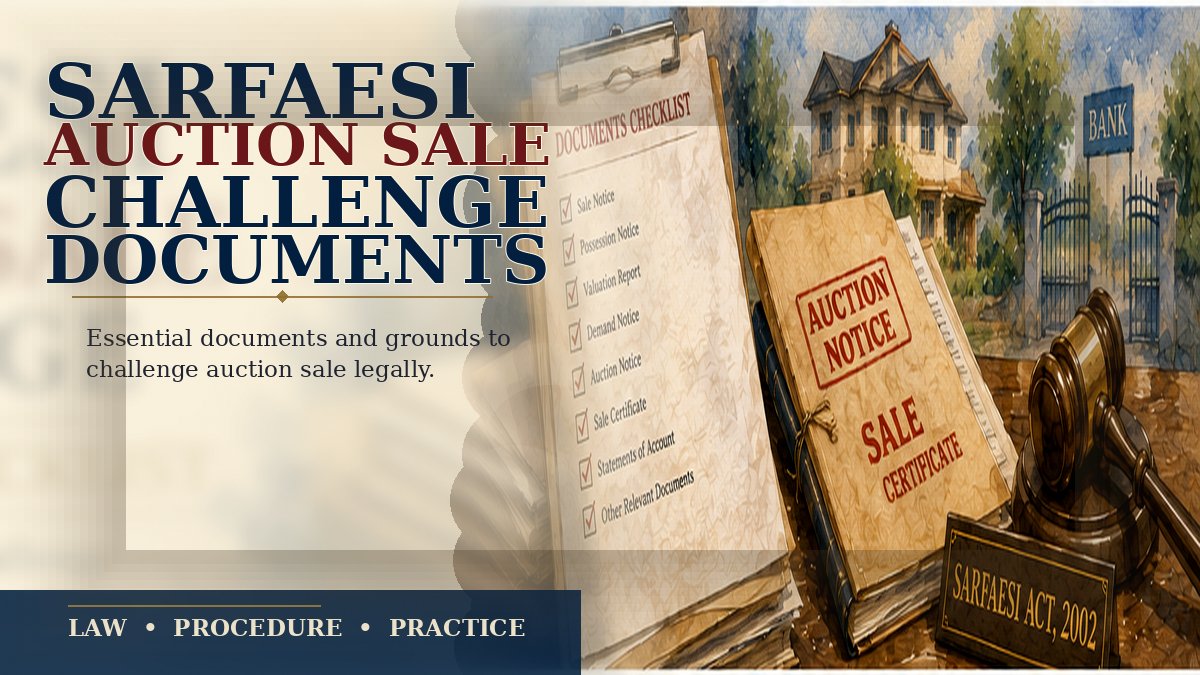
SARFAESI proceedings move quickly, but the record must still show compliance with the SARFAESI Act, 2002 and the Security Interest (Enforcement) Rules, 2002. In auction-sale disputes, dates and documents often decide whether the sale process has attained finality, whether the borrower can still raise a redemption-related issue, and whether the auction purchaser's rights have crystallised.
In E. Muthurathinasabathy & Ors. v. M/s. Sri International & Ors., 2026 INSC 303, the Supreme Court considered a SARFAESI auction dispute involving delayed payment of balance sale consideration, judicial proceedings before DRT/DRAT/High Court, and repayment of the outstanding liability by the borrower during the proceedings. The decision is useful for document preparation in borrower, secured creditor and auction-purchaser disputes.
Case Metadata
Why This Topic Matters
A borrower, secured creditor and auction purchaser may each rely on different parts of the SARFAESI record. A borrower may point to repayment, procedural irregularity or statutory non-compliance. A secured creditor may rely on sale notices, auction terms and recovery steps. An auction purchaser may rely on bid acceptance, deposit and sale certificate. The dispute therefore requires a document-first review rather than a general statement that a sale has or has not become final.
Rule 9(4) And Balance Consideration
Rule 9(4) of the Security Interest (Enforcement) Rules, 2002 concerns payment of the balance purchase price by the auction purchaser within the prescribed time, subject to the rule framework. Where the timeline is disputed, the exact auction date, 25% deposit date, communication of confirmation, balance payment date, extension if any, and court/tribunal orders must be arranged chronologically.
Borrower's Redemption-Related Documents
A borrower seeking to challenge or resist finality of an auction sale should prepare a complete record of repayment efforts, proceedings and statutory notices. The focus should be on dates, amounts, orders and whether the sale process was completed in accordance with law.
- Loan sanction, mortgage/security documents and account statement.
- Section 13(2) demand notice and proof of service.
- Reply or representation to the secured creditor, if any.
- Section 13(4) possession notice and publication record.
- Auction notice, reserve price, bid terms and sale publication.
- DRT, DRAT and High Court pleadings, interim orders and final orders.
- Payment proof, deposit receipts, one-time settlement record or liability discharge record.
- Date chart showing auction, deposit, stay/interim orders, balance payment and sale certificate events.
Secured Creditor's Document Review
A secured creditor should be able to show a clean statutory record from classification of the account to sale completion. This includes service, valuation, publication, bid process, payment compliance and correspondence with the auction purchaser and borrower.
- NPA classification record and statement of outstanding dues.
- Demand notice, possession notice and publication proof.
- Valuation report and reserve price decision.
- Auction terms and bid documents.
- Proof of 25% deposit and balance sale consideration.
- Lender approvals, sale confirmation communication and sale certificate record.
- Any DRT/DRAT/High Court order affecting continuation or confirmation of sale.
Auction Purchaser's Document Review
An auction purchaser should keep all bid, payment and confirmation documents ready. If the sale is challenged, the purchaser's timeline and compliance with payment conditions become important.
- Bid application and auction terms accepted.
- Proof of earnest money and 25% deposit.
- Communication from secured creditor regarding successful bid or confirmation.
- Balance payment proof and date of payment.
- Sale certificate, registration details and possession documents, if any.
- Correspondence explaining any delay or restraint caused by court/tribunal proceedings.
Common Mistakes
- Not preparing a single date chart for the entire SARFAESI timeline.
- Ignoring the difference between auction, confirmation, balance payment, sale certificate and registration.
- Assuming that issuance of a sale certificate automatically answers every statutory-compliance issue.
- Not preserving DRT/DRAT/High Court interim orders that affected the sale process.
- Failing to collect proof of full or partial payment by the borrower during pending proceedings.
- Reviewing the case only from the borrower side or only from the auction purchaser side.
Enquiry Format
For a structured first review of a SARFAESI auction-sale issue, prepare the following details:
- Party position: borrower / guarantor / secured creditor / auction purchaser / third-party claimant.
- Property details: secured asset description, location, possession status and registration status.
- Notices: Section 13(2), Section 13(4), possession notice and auction notice dates.
- Auction timeline: auction date, 25% deposit, confirmation, balance payment, sale certificate and registration.
- Proceedings: DRT, DRAT, High Court or Supreme Court case status and orders.
- Payments: outstanding amount, borrower deposits, OTS terms, auction purchaser deposits and balance payment.
- Urgency: possession date, registration, next hearing, limitation or pending sale steps.
Related Site Resources
Official Judgment
References / Sources
- Relevant SARFAESI Act provisions, Security Interest Enforcement Rules, DRT records and auction documents should be checked with the case file.
- This article is a general informational note and should be read with the actual documents, dates, forum rules and limitation position.
This article is an original Chambers of AK explainer based on the Supreme Court judgment. Readers should refer to the judgment PDF for the complete text, facts, reasoning and operative directions.
Download JudgmentArrange notices, auction documents, payment proof, tribunal orders and a date chart before sending a first enquiry. Do not send confidential or privileged material until a formal engagement is confirmed.
Start Case Enquiry