Last updated: May 2026.
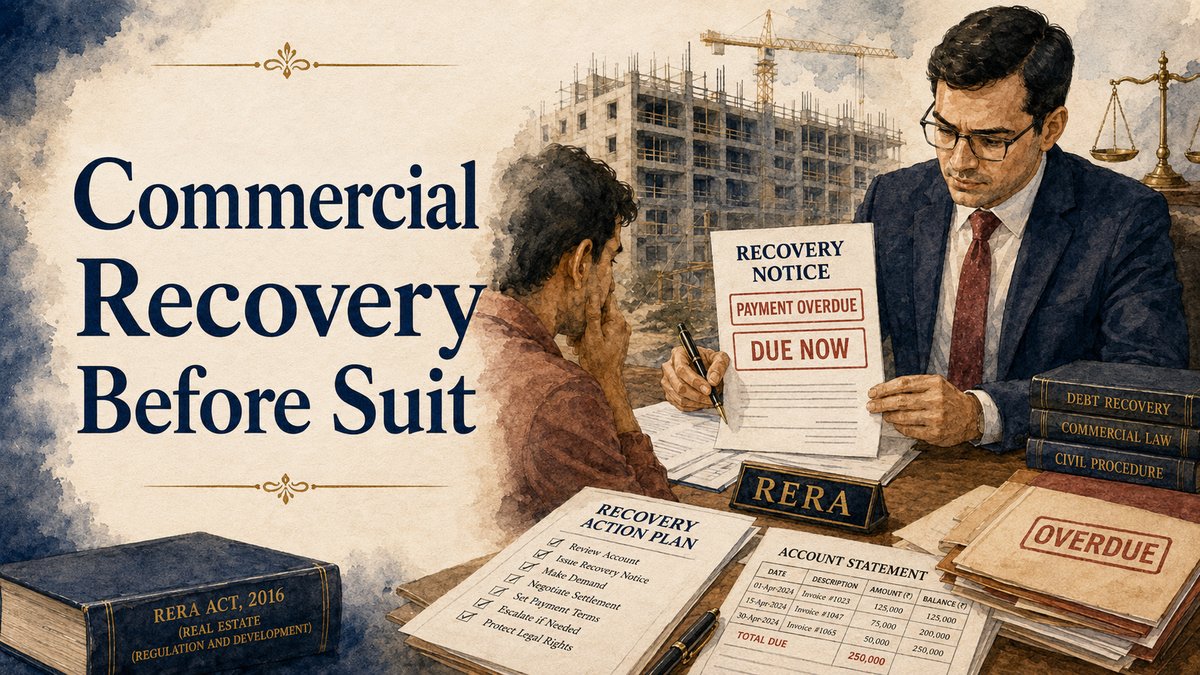
Commercial recovery claims usually depend on proving the transaction, supply or service, payment terms, outstanding amount, demand record, buyer response and limitation. A clear document set helps assess whether a notice, negotiation, arbitration, civil suit or commercial suit route may be appropriate.
Before taking any procedural step, prepare an invoice-wise and date-wise summary. This reduces ambiguity and helps identify admissions, part-payments, objections and limitation issues.
The same claim may look different depending on the forum route. A matter with an arbitration clause, a commercial-court issue, an MSME supplier, a continuing account or an urgent injunction requirement may need different preparation even if the unpaid amount is the same.
Contract And Order Papers
- Written contract, purchase order or work order.
- Accepted quotation or proposal.
- Terms and conditions.
- Arbitration, jurisdiction or payment clause.
Invoice And Supply Records
- Invoices with dates and amounts.
- Delivery challans, e-way bills or dispatch proof.
- Completion certificates or service proof.
- GST and tax records, if relevant.
Payment And Accounts
- Ledger statement and account summary.
- Bank statements showing payments.
- Balance confirmation or account acknowledgement.
- Invoice-wise outstanding table.
Preserve emails, WhatsApp messages, letters, payment reminders, meeting notes, admission messages, settlement proposals and buyer objections. Where the buyer alleges defect, delay, debit note, set-off or reconciliation difference, keep the complete sequence of communication.
Written admissions, part-payments and account confirmations can be important. Their legal effect depends on timing, wording, authenticity and surrounding documents.
If messages are relied upon, export or preserve them with sender details, date, time and surrounding context. Cropped screenshots without context can create avoidable disputes about authenticity or meaning.
Prepare dates for invoice, supply, due date, last payment, last written acknowledgement, legal notice and reply. Limitation analysis may change depending on contract terms, continuing account records, part-payments and written admissions.
Also check whether the contract has an arbitration clause, exclusive jurisdiction clause, pre-litigation notice requirement or dispute resolution procedure. These details can affect the next procedural step.
Where urgent relief is being considered, preserve evidence showing risk of asset transfer, record destruction, supply disruption, third-party creation, encashment, diversion or other immediate prejudice. Urgency should be supported by documents, not only by a general statement.
Common mistakes include sending inconsistent outstanding amounts, ignoring debit notes, relying only on ledger entries without supply proof, overlooking jurisdiction or arbitration clauses, delaying despite limitation concerns, and failing to separate principal, interest, penalty and tax components.
For first review, a short claim table is useful: invoice number, date, due date, amount, payment received, balance, supporting document and buyer response. This table often reveals whether the matter is ready for notice, negotiation, arbitration or court review.
A useful first enquiry may include business name, opposite party name and location, contract date, invoice-wise outstanding amount, due dates, last payment date, buyer objections, notice record and whether any proceeding is already pending.
If a notice, mediation, arbitration or suit is already pending, mention the case number, forum, next date, pleadings exchanged and any interim order. This helps avoid repeating steps already taken.
Related resources: commercial recovery practice page, commercial contract review checklist, commercial recovery lawyer in Bihar, commercial recovery lawyer in Patna, before filing a commercial recovery suit, and the case enquiry guide.
This article is for general legal information and enquiry preparation. It is not legal advice, does not create an advocate-client relationship, and does not guarantee any outcome. Commercial recovery strategy depends on facts, documents, limitation, jurisdiction, forum and formal consultation.
References / Sources
- Relevant Commercial Courts Act provisions, CPC pleadings, contracts, invoices, ledgers and recovery correspondence should be checked with the case file.
- This article is a general informational note and should be read with the actual documents, dates, forum rules and limitation position.